
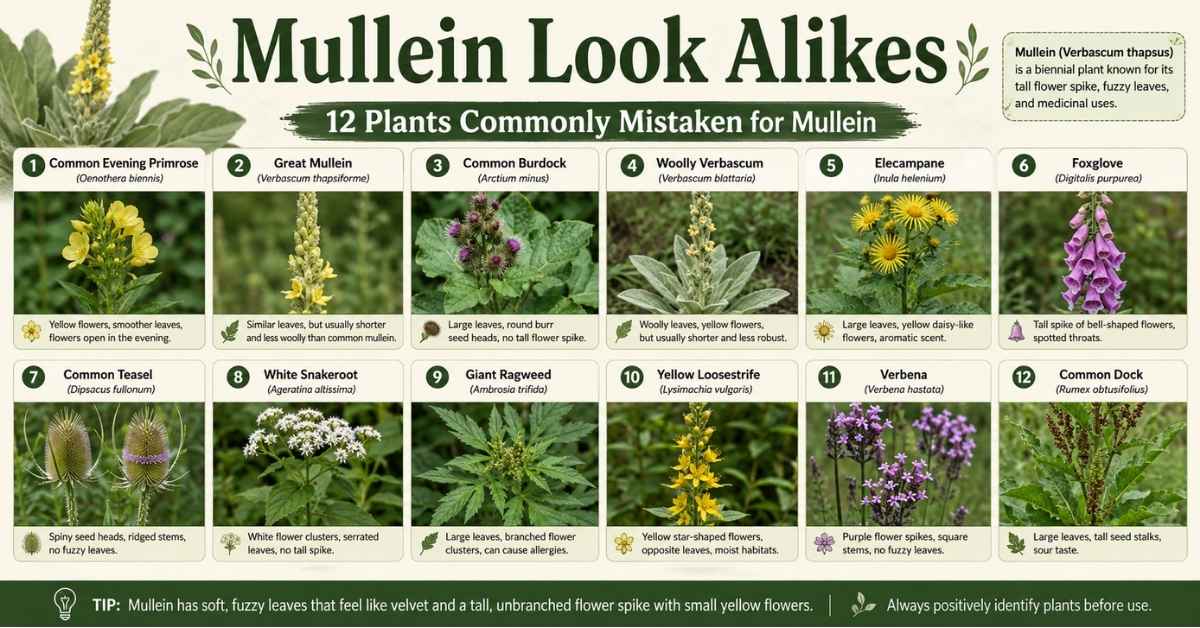
Mullein look alikes include lamb’s ear, foxglove, comfrey, burdock, houndstongue, common teasel, velvetleaf, and several other fuzzy-leaved plants that can easily confuse gardeners, herbalists, and beginner foragers. The easiest way to identify true mullein is by its thick woolly leaves, gray-green color, basal rosette growth pattern, and tall yellow flower spike during its second year. Learning how to distinguish these plants is important because some look-alikes have different medicinal properties, while others may be toxic or unsuitable for harvesting.
If you’ve ever spotted a soft, fuzzy plant growing along a roadside, meadow, or abandoned field and wondered whether it was mullein, you’re not alone. Many plants share similar characteristics, especially during the first-year rosette stage, when mullein has not yet developed its famous flowering stalk. This guide will help you confidently identify common mullein, compare it with the most common look-alikes, and avoid potentially dangerous mistakes.
Quick Answer: What Plants Look Like Mullein?
Several plants resemble mullein because they have fuzzy leaves, gray-green foliage, or rosette growth habits. The most commonly confused species include:
| Plant | Similarity Level | Toxicity Risk |
|---|---|---|
| Lamb’s Ear | Very High | Low |
| Foxglove | High | High |
| Comfrey | High | Low |
| Burdock | Medium | Low |
| Houndstongue | Medium | Moderate |
| Common Teasel | Medium | Low |
| Velvetleaf | Medium | Low |
| Horehound | Low | Low |
Among these, foxglove is the most important look-alike to recognize correctly because it contains toxic compounds that can be dangerous if ingested.
Why People Mistake Other Plants for Mullein
Plant identification mistakes usually happen because many species share the same visual traits during early growth stages.
The Fuzzy-Leaf Trap
When most people search for plants that look like mullein, they focus on one characteristic: fuzzy leaves.
Unfortunately, dozens of species have leaves covered in tiny hairs known as trichomes. These hairs create a velvety texture that can make unrelated plants appear nearly identical from a distance.
A beginner often sees:
- Soft leaves
- Gray-green color
- Rosette growth
- Large leaf size
and immediately assumes the plant is mullein.
Why First-Year Mullein Causes Confusion
During its first year, common mullein (Verbascum thapsus) forms a low-growing basal rosette close to the ground.
At this stage, there is no flowering stalk to help with identification.
As a result, plants such as:
- Foxglove
- Comfrey
- Lamb’s ear
- Houndstongue
are commonly mistaken for mullein.
Why Online Photos Can Be Misleading
Many identification guides only show mature flowering mullein.
However, most people encounter:
- Seedlings
- Rosettes
- Immature plants
This creates confusion because young mullein looks dramatically different from its second-year flowering form.
What Real Mullein Looks Like at Every Stage of Growth
Understanding the plant’s complete life cycle is one of the easiest ways to identify mullein in the wild.
First-Year Mullein Rosette
The first year is when most identification mistakes occur.
Characteristics include:
- Thick woolly leaves
- Gray-green coloration
- Soft velvety texture
- Oval to lance-shaped leaves
- Dense leaf hairs covering both sides
The leaves emerge in a circular pattern close to the ground, creating a distinctive basal rosette.
Unlike many look-alikes, true mullein feels almost like felt when touched.
Second-Year Flowering Mullein
During the second growing season, mullein produces its famous flowering stalk.
Key features include:
- Height of 4–8 feet
- Single upright stem
- Bright yellow flowers
- Dense flower spike
- Large lower leaves
The tall yellow flower spike is often the easiest way to distinguish mullein from similar plants.
Mature Seed-Producing Plants
After flowering, mullein develops seed capsules along the stalk.
These seed heads:
- Remain visible through winter
- Release thousands of seeds
- Help identify the plant even after leaves die back
Many experienced foragers use old stalks to locate future mullein populations.
The 60-Second Mullein Identification Test
If you’re unsure whether you’ve found mullein, use this quick field checklist.
Check the Leaves
True mullein leaves are:
- Thick
- Broad
- Soft
- Uniformly fuzzy
Check the Texture
Run your fingers across both sides.
Mullein feels:
- Velvety
- Woolly
- Soft
Many look-alikes feel rougher or less densely hairy.
Check the Flower Spike
Flowering mullein has:
- Yellow flowers
- Tall central stalk
- Dense flower clusters
Purple, pink, or white flowers typically indicate another species.
Check the Habitat
Mullein commonly grows in:
- Disturbed soil
- Roadsides
- Dry fields
- Gravel lots
- Open meadows
Check the Season
Identification becomes easier during:
- Late spring
- Summer
- Early fall
Flower spikes provide strong visual confirmation.
When You Should Not Harvest
Avoid harvesting if:
- Flowers don’t match expected appearance
- Leaf texture feels unusual
- Plant characteristics seem inconsistent
- You cannot identify the species with confidence
When in doubt, leave the plant alone.
Mullein Look Alikes Ranked by Confusion Risk
| Look-Alike | Confusion Level | Identification Difficulty | Toxicity Concern |
|---|---|---|---|
| Lamb’s Ear | Very High | Easy | Low |
| Foxglove | High | Moderate | High |
| Comfrey | High | Moderate | Low |
| Burdock | Medium | Easy | Low |
| Houndstongue | Medium | Moderate | Moderate |
| Common Teasel | Medium | Easy | Low |
| Velvetleaf | Medium | Easy | Low |
| Horehound | Low | Easy | Low |
Lamb’s Ear vs Mullein
Lamb’s Ear (Stachys byzantina) is probably the most common mullein look alike.
Why They Look Similar
Both species have:
- Silvery leaves
- Dense fuzz
- Soft texture
- Gray-green appearance
From a distance, they can appear nearly identical.
Key Differences
| Feature | Mullein | Lamb’s Ear |
|---|---|---|
| Growth Habit | Upright biennial | Low spreading perennial |
| Flower Color | Yellow | Purple |
| Height | Up to 8 feet | Usually under 2 feet |
| Leaf Arrangement | Rosette then stalk | Clumping growth |
Habitat Differences
Lamb’s ear is commonly planted in gardens.
Mullein is usually found growing wild in disturbed areas.
Foxglove vs Mullein
This comparison deserves special attention because foxglove can be toxic.
Why Foxglove Is Dangerous
Foxglove (Digitalis purpurea) contains cardiac glycosides that can be harmful if consumed.
Rosette-Stage Similarities
Young foxglove often resembles first-year mullein.
Both plants produce:
- Large leaves
- Basal rosettes
- Fuzzy surfaces
This similarity causes many identification errors.
Flower Differences
Once flowering begins, the distinction becomes obvious.
Mullein:
- Yellow flowers
- Dense flower spike
Foxglove:
- Purple flowers
- Bell-shaped blooms
- Hanging flower clusters
Quick Identification Tip
If the flowers are purple, pink, or white instead of yellow, it is not common mullein.
Comfrey vs Mullein
Comfrey (Symphytum officinale) is another plant that frequently appears on lists of plants that look like mullein. Both species produce large leaves and can appear similar when viewed from a distance.
Why They Look Similar
Comfrey and mullein share:
- Large leaves
- Rosette-like early growth
- Roughly similar leaf shape
- Wild-growing habit
This often leads beginners to confuse the two species before flowering begins.
Key Differences
| Feature | Mullein | Comfrey |
|---|---|---|
| Leaf Texture | Thick and woolly | Rough and bristly |
| Flower Color | Yellow | Purple, pink, or cream |
| Stem | Single upright stalk | Multiple branching stems |
| Leaf Feel | Velvety soft | Coarse and prickly |
The easiest distinction is texture. Mullein feels soft and fuzzy, while comfrey feels rough because of its stiff hairs.
Habitat Differences
Comfrey prefers:
- Moist soils
- Garden edges
- Streambanks
- Fertile ground
Mullein prefers:
- Dry soils
- Roadsides
- Gravel lots
- Disturbed ground
Burdock vs Mullein
Burdock (Arctium spp.) often confuses people because of its large leaves.
Why Beginners Mistake Burdock for Mullein
When young, burdock develops broad leaves that can resemble a mullein rosette from above.
Key Differences
| Feature | Mullein | Burdock |
|---|---|---|
| Leaf Surface | Woolly on both sides | Mostly smooth on top |
| Leaf Shape | Oval to lance-shaped | Heart-shaped |
| Flowering Structure | Yellow flower spike | Purple burr flowers |
| Height | 4–8 feet | 3–6 feet |
Root Structure Differences
Burdock develops a thick taproot commonly harvested as an edible vegetable.
Mullein also develops a taproot but is primarily recognized for its leaves and flowers rather than its root.
LEARN MORE: Can Chickens Eat Rockmelon Seeds?
Houndstongue vs Mullein
Houndstongue (Cynoglossum officinale) is one of the more overlooked mullein look alikes.
Why It Causes Confusion
Young houndstongue plants have:
- Gray-green foliage
- Soft-looking leaves
- Rosette growth
These traits can resemble first-year mullein.
Key Differences
| Feature | Mullein | Houndstongue |
|---|---|---|
| Leaf Texture | Thick woolly fuzz | Softer but less dense fuzz |
| Flower Color | Yellow | Reddish-purple |
| Leaf Shape | Broader and thicker | Narrower and longer |
| Toxicity | Generally non-toxic | Contains toxic alkaloids |
Toxicity Considerations
Houndstongue contains compounds that may cause health concerns if consumed. Correct identification is important before harvesting any wild plant.
Common Teasel vs Mullein
Common teasel (Dipsacus fullonum) can resemble mullein during certain stages of growth.
Early Growth Similarities
Before flowering, teasel forms a basal rosette similar to many biennial plants.
This is where confusion often begins.
Flowering Differences
Once mature, the plants become easy to distinguish.
Mullein develops:
- Yellow flower spikes
- Woolly leaves
Teasel develops:
- Purple flower heads
- Spiny stems
- Distinctive seed heads
Seed Head Identification
Teasel seed heads remain visible throughout winter and are among the easiest identifying features of the species.
Velvetleaf vs Mullein
Velvetleaf (Abutilon theophrasti) is named for its soft leaf texture, making it another plant often mistaken for mullein.
Why Fuzzy Leaves Create Confusion
Velvetleaf has:
- Soft leaf hairs
- Large leaves
- Upright growth habit
At first glance, these traits resemble young mullein plants.
Fast Identification Tricks
Look at the leaf shape.
Velvetleaf leaves are:
- Broad
- Heart-shaped
Mullein leaves are:
- Longer
- More oval
- More densely woolly
Other Plants Frequently Mistaken for Mullein
Several additional species occasionally appear in plant identification discussions.
Evening Primrose
Young rosettes can resemble mullein before flowering.
Horehound
Gray-green foliage creates occasional confusion.
Marsh Mallow
Soft leaves and similar habitat preferences can mislead beginners.
Tobacco Species
Some wild tobacco plants produce fuzzy leaves resembling mullein.
Other Verbascum Species
Several related species within the Verbascum genus resemble common mullein and may require close examination to identify correctly.
Dangerous Plants That Can Be Mistaken for Mullein
Not every mullein look alike is harmless.
Some species pose genuine risks.
Toxic Plants to Watch For
| Plant | Risk Level |
|---|---|
| Foxglove | High |
| Houndstongue | Moderate |
| Certain ornamental species | Variable |
Warning Signs You Should Stop Harvesting
Do not harvest if:
- Flower color doesn’t match
- Leaf texture feels unusual
- Plant growth pattern differs significantly
- You are relying on a single identification characteristic
When to Consult an Expert
If uncertainty remains, consult:
- Local extension offices
- Experienced foragers
- Native plant societies
- Botanical gardens
Mullein vs Look-Alikes Comparison Table
| Characteristic | Mullein | Foxglove | Lamb’s Ear | Comfrey |
|---|---|---|---|---|
| Fuzzy Leaves | Yes | Moderate | Yes | Moderate |
| Yellow Flowers | Yes | No | No | No |
| Woolly Texture | Yes | No | Yes | No |
| Tall Flower Spike | Yes | Yes | No | No |
| Toxicity Concern | Low | High | Low | Low |
Where Mullein Typically Grows
Habitat is one of the strongest clues for accurate identification.
Roadsides
Mullein frequently colonizes roadside environments where soil has been disturbed.
Dry Meadows
Open sunny fields are common locations.
Gravel Lots
Poor soil conditions rarely discourage mullein growth.
Abandoned Fields
Old agricultural land often contains thriving mullein populations.
Disturbed Ground
Construction sites, pathways, and neglected areas commonly support mullein growth.
Places Where Mullein Rarely Grows
Habitat can also eliminate incorrect identifications.
Dense Forests
Mullein requires abundant sunlight.
Wetlands
Constant moisture is generally unfavorable.
Deep Shade
Poor light conditions restrict growth.
Flood-Prone Areas
Mullein performs poorly in waterlogged soils.
The Most Common Mullein Identification Mistakes
Trusting Leaf Fuzz Alone
Many fuzzy plants are not mullein.
Ignoring Flowers
Flower color remains one of the strongest identifying characteristics.
Using One Photo
Plant identification requires examining multiple features.
Ignoring Habitat
Habitat clues often reveal misidentifications immediately.
Harvesting Too Early
Waiting until flowering can significantly improve accuracy.
How Experienced Foragers Confirm Mullein Identification
Professional plant identifiers rarely rely on one characteristic.
Multiple-Trait Verification
Experts examine:
- Leaf texture
- Flower structure
- Growth habit
- Habitat
- Seasonal stage
Entire Plant Evaluation
Looking at only a leaf increases error rates.
The entire plant tells a much clearer story.
Seasonal Awareness
Experienced foragers understand how appearance changes throughout the year.
Population Comparison
Finding several similar plants nearby often improves confidence.
Why Experts Don’t Depend Entirely on Apps
Plant identification apps are useful but not foolproof. Lighting, camera angle, and plant age can all affect results.
Real-World Identification Scenarios
Scenario 1: A Fuzzy Rosette in Early Spring
You discover a gray-green rosette beside a gravel road.
Questions to ask:
- Are both leaf surfaces woolly?
- Is the texture velvety?
- Is the plant growing in disturbed soil?
If yes, mullein becomes a strong possibility.
Scenario 2: A Tall Yellow Flower Spike in Summer
A plant stands over six feet tall with yellow flowers arranged along a central spike.
This combination strongly suggests common mullein.
Scenario 3: A Soft Plant Growing in a Garden Border
Check for purple flowers.
Garden ornamentals such as lamb’s ear may resemble mullein but flower differently.
Scenario 4: A Woolly Plant Near Wet Soil
Mullein prefers dry conditions.
Wet habitats may indicate another species.
LEARN MORE: Cherry Harvest Labor Shortage
Can You Safely Harvest Mullein?
Signs You Have Correctly Identified Mullein
- Thick woolly leaves
- Yellow flower spike
- Gray-green coloration
- Disturbed-soil habitat
- Biennial growth pattern
Signs You Should Not Harvest
- Uncertain identification
- Unusual flowers
- Unexpected habitat
- Conflicting characteristics
Roadside Contamination Concerns
Even correctly identified mullein may absorb pollutants from heavily trafficked roadsides.
Choose harvesting sites away from traffic whenever possible.
Ethical Wildcrafting Practices
Responsible harvesting includes:
- Taking only what you need
- Leaving healthy populations intact
- Respecting local regulations
- Avoiding sensitive ecosystems
Mullein Identification Cheat Sheet
Five Signs It Is Probably Mullein
- Woolly gray-green leaves
- Dense leaf hairs on both sides
- Basal rosette during year one
- Tall yellow flower spike during year two
- Growth in sunny disturbed areas
Five Red Flags
- Purple flowers
- Heart-shaped leaves
- Smooth leaf surfaces
- Wetland habitat
- Lack of dense fuzz
Frequently Asked Questions
What plant is most commonly mistaken for mullein?
Lamb’s ear and foxglove are among the most common mullein look alikes.
Does foxglove look like mullein?
Yes. Young foxglove plants often resemble first-year mullein rosettes before flowering begins.
Is lamb’s ear the same as mullein?
No. Although both have fuzzy leaves, they are completely different species.
Can mullein be poisonous?
Common mullein is generally considered non-toxic, but proper identification is always essential.
What does first-year mullein look like?
It appears as a low-growing basal rosette with thick woolly leaves.
What weeds resemble mullein?
Velvetleaf, burdock, teasel, houndstongue, and several other species can resemble mullein.
How can I identify mullein with confidence?
Use multiple characteristics including leaf texture, flower color, habitat, and growth stage.
Is mullein invasive?
In some regions, common mullein is considered an invasive or naturalized species due to its prolific seed production.
Final Thoughts: The Safest Way to Identify Mullein in the Wild
The easiest way to distinguish mullein look alikes from true mullein is to examine the entire plant rather than focusing on a single feature. While fuzzy leaves often attract attention first, experienced foragers rely on a combination of leaf texture, flower structure, growth habit, habitat, and seasonal appearance before making an identification.
Remember that foxglove, houndstongue, lamb’s ear, comfrey, burdock, common teasel, velvetleaf, and other fuzzy-leaved plants can resemble mullein under certain conditions. By using the identification frameworks and comparison techniques outlined in this guide, you can recognize common mullein with greater confidence and reduce the risk of harvesting the wrong plant.
For beginners, the safest approach is simple: if you are not completely certain, wait until the plant flowers or seek verification from a qualified local expert before harvesting.