
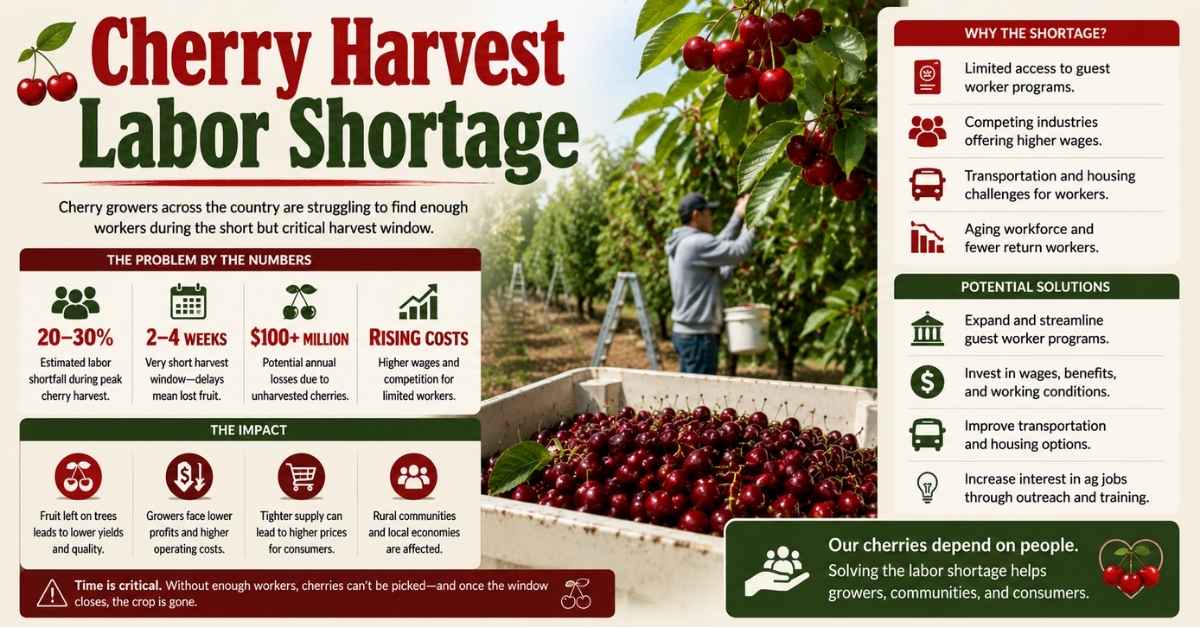
Cherry harvest labor shortage is one of the biggest challenges facing modern fruit growers. In simple terms, it refers to the growing difficulty cherry orchards face in finding enough seasonal workers during harvest season. The shortage affects everything from crop yields and fruit quality to farm profitability, labor costs, supply chains, and consumer prices. As fewer workers become available and harvest windows remain extremely short, many growers are struggling to pick cherries before they become overripe or unmarketable.
For cherry producers, the issue goes far beyond hiring challenges. Labor shortages can mean thousands of dollars in lost revenue, rising wage expenses, and difficult decisions about investing in automation, orchard redesign, or foreign labor programs. For consumers, the effects may eventually show up as higher cherry prices and reduced market availability.
This guide explores the causes of the cherry harvest labor shortage, its economic impact, regional trends, technology solutions, and what the future of cherry production may look like in the coming years.
Quick Answer: What Is the Cherry Harvest Labor Shortage?
The cherry harvest labor shortage is the lack of sufficient seasonal workers needed to pick cherries during the limited harvest period.
Cherry Harvest Labor Shortage at a Glance
| Factor | Impact |
|---|---|
| Worker availability | Decreasing |
| Harvest costs | Increasing |
| Labor competition | Intensifying |
| Crop loss risk | Growing |
| Automation demand | Rising |
| Profit margins | Under pressure |
The challenge affects growers worldwide, particularly in regions heavily dependent on seasonal agricultural labor.
Why Cherry Harvest Labor Matters More Than Most People Realize
Most consumers see cherries in grocery stores and rarely think about what happens before the fruit reaches the shelf.
The reality is that cherry harvesting is one of the most labor-intensive activities in fruit production.
The Race Against Time During Cherry Season
Unlike many agricultural commodities, cherries have a very short harvest window.
Once cherries reach peak ripeness, growers often have only:
- 10 to 21 days
- Limited weather opportunities
- Strict market deadlines
to harvest and ship fruit.
Missing this window can dramatically reduce market value.
What Happens When Orchards Can’t Find Enough Workers?
Labor shortages create a chain reaction:
- Fewer workers available
- Slower harvesting
- Fruit remains on trees
- Quality declines
- Revenue decreases
In severe cases, growers may leave part of the crop unharvested.
The Human Side of the Problem
For many family-owned orchards, labor shortages create enormous stress.
Growers worry about:
- Meeting harvest deadlines
- Paying rising wages
- Maintaining profitability
- Preserving fruit quality
For seasonal workers, uncertainty around employment, housing, and transportation creates challenges as well.
How Cherry Harvesting Actually Works
Understanding why labor shortages matter requires understanding how cherries are harvested.
Why Cherries Are Still Picked by Hand
Unlike grains or some row crops, fresh-market cherries are highly sensitive.
Consumers expect cherries to arrive:
- Firm
- Undamaged
- Uniform
- Attractive
Mechanical harvesting often risks bruising the fruit.
As a result, many premium cherry orchards continue relying on manual harvesting.
The Skills Required to Harvest Cherries
Cherry picking is physically demanding and requires more skill than many people realize.
Workers must:
- Identify ripe fruit
- Avoid damaging stems
- Handle fruit carefully
- Maintain speed and efficiency
Experienced workers are often significantly more productive than new hires.
How Many Workers Does a Typical Orchard Need?
Labor requirements vary depending on orchard size.
| Orchard Size | Estimated Seasonal Workers |
|---|---|
| Small orchard | 10–30 workers |
| Medium orchard | 30–100 workers |
| Large commercial operation | Hundreds of workers |
Large cherry-producing regions may require thousands of seasonal workers simultaneously.
When Did the Labor Shortage Become a Major Problem?
The labor shortage did not appear overnight.
Historical Labor Trends in Agriculture
For decades, fruit production relied heavily on seasonal labor pools.
Historically, growers could access workers through:
- Local communities
- Migrant labor networks
- Seasonal workforce programs
However, labor availability has gradually changed.
Changes in the Agricultural Workforce
Several long-term trends have affected worker availability:
- Aging workforce
- Declining rural populations
- Alternative employment opportunities
- Urban migration
These factors have reduced the number of workers willing to perform physically demanding seasonal jobs.
Why the Challenge Has Intensified
Recent labor shortages have become more noticeable because:
- Labor demand remains high
- Worker supply has tightened
- Production costs continue rising
- Harvest timing remains inflexible
The result is increased competition among growers for available workers.
The Real Causes Behind the Cherry Harvest Labor Shortage
Many articles simplify the issue.
The reality is much more complex.
Shrinking Seasonal Labor Pools
Fewer workers are entering agricultural employment than in previous generations.
Many younger workers pursue:
- Manufacturing jobs
- Warehousing positions
- Transportation careers
- Service industry employment
These industries often offer year-round employment.
Aging Agricultural Workforce
A significant portion of experienced farm labor is aging.
As workers retire, fewer replacements are entering the field.
Rural Population Decline
Many agricultural regions face population declines.
Fewer local residents means fewer potential seasonal workers.
Competition From Other Industries
Agriculture competes with sectors such as:
- Construction
- Logistics
- Warehousing
- Retail distribution
These industries frequently offer:
- Consistent schedules
- Longer employment periods
- Less seasonal uncertainty
Worker Housing Challenges
Housing shortages create additional obstacles.
Many orchards are located in rural areas where affordable worker housing is limited.
Transportation Barriers
Seasonal workers often face transportation difficulties, particularly when orchards are spread across large geographic regions.
Immigration and Workforce Availability
Immigration policy remains a significant factor influencing labor availability.
Many fruit-producing regions rely heavily on seasonal foreign workers.
Changes in visa availability, processing times, and regulatory requirements can directly affect workforce supply.
H-2A Program Limitations
The H-2A temporary agricultural worker program helps address labor shortages.
However, growers often cite challenges such as:
- Administrative complexity
- Housing requirements
- Compliance costs
- Processing delays
While helpful, the program is not a complete solution.
Why Higher Wages Alone Haven’t Solved the Problem
One common assumption is that growers simply need to pay more.
The reality is more complicated.
The Economics of Cherry Production
Cherry farming operates within tight margins.
Growers already face expenses related to:
- Land
- Irrigation
- Fertilizer
- Equipment
- Fuel
- Packaging
- Transportation
Labor is often one of the largest production costs.
Labor Cost vs Profitability
Raising wages may attract workers, but it also increases production expenses.
Higher labor costs can reduce profitability unless growers can:
- Increase prices
- Improve efficiency
- Boost productivity
The Limits of Wage Increases
Even when wages rise, growers still compete with industries offering:
- Year-round employment
- Predictable schedules
- Reduced physical demands
For many workers, these factors matter as much as hourly pay.
The Financial Impact on Cherry Growers
Labor shortages create direct economic consequences.
Rising Harvest Costs
As worker availability declines, growers often increase:
- Wages
- Recruitment expenses
- Retention incentives
- Transportation support
These costs add pressure to already thin margins.
Revenue Lost From Unpicked Fruit
Perhaps the most serious consequence is unharvested fruit.
Every cherry left on a tree represents lost revenue.
In severe shortages, growers may be forced to prioritize the highest-value blocks while leaving lower-value fruit unpicked.
Profit Margin Compression
When costs rise and yields decline, profitability suffers from both directions.
This makes long-term sustainability increasingly difficult for some operations.
Small Farms vs Large Operations
| Farm Type | Labor Risk Exposure |
|---|---|
| Small farms | High |
| Medium farms | Moderate |
| Large farms | Lower but significant |
Larger operations often have greater resources for recruitment and workforce planning.
What Happens When Cherries Aren’t Picked on Time?
Timing is everything in cherry production.
Fruit Quality Declines Quickly
Overripe cherries may become:
- Softer
- Less attractive
- More vulnerable to damage
This reduces market value.
Marketability Problems
Retailers and exporters maintain strict quality standards.
Fruit that misses those standards may receive lower prices or be rejected entirely.
Supply Chain Consequences
Delayed harvesting affects:
- Packing schedules
- Shipping logistics
- Retail distribution
A labor shortage in the orchard can ripple throughout the entire supply chain.
How Labor Shortages Affect Cherry Prices
Many consumers never connect labor shortages with the price of cherries at the grocery store. However, labor availability has a direct impact on the fruit supply chain.
Supply and Demand Dynamics
When fewer workers are available to harvest cherries:
- Fewer cherries reach the market
- Marketable yields decline
- Supply tightens
If consumer demand remains strong while supply falls, prices often increase.
Wholesale Market Effects
Labor shortages can raise costs throughout the production process.
Growers may spend more on:
- Recruitment
- Seasonal worker housing
- Transportation
- Overtime labor
- Labor retention programs
These increased expenses often move through the supply chain.
Retail Price Impacts
Consumers may notice:
- Higher fresh cherry prices
- Shorter availability windows
- Reduced promotional pricing
The effect varies by region and harvest season, but labor challenges frequently contribute to market volatility.
Export Market Consequences
Countries that export cherries depend heavily on reliable harvest labor.
Missed harvest windows can reduce export volumes and affect international competitiveness.
LEARN MORE: Can Chickens Eat Rockmelon Skin?
Which Cherry-Producing Regions Are Most Affected?
The cherry harvest labor shortage is not limited to one location.
Many of the world’s major cherry-producing regions face similar workforce challenges.
Washington State
Washington is one of the largest sweet cherry-producing regions in North America.
Growers often rely on:
- Seasonal workers
- H-2A labor programs
- Recruitment networks
Because harvest periods overlap among orchards, competition for workers can be intense.
California
California producers face additional pressure from:
- High labor costs
- Housing shortages
- Strong competition from other industries
Oregon
Oregon growers often encounter similar recruitment challenges, particularly during peak harvest periods.
Michigan
Michigan’s tart cherry industry faces labor concerns while also managing weather-related production risks.
British Columbia
Canadian producers have increasingly relied on temporary foreign worker programs to fill labor gaps.
Chile
Chile is a major global exporter of cherries.
Labor shortages during harvest season can affect export volumes to key international markets.
Turkey
As one of the world’s largest cherry producers, Turkey faces ongoing labor management challenges in certain production regions.
European Cherry-Producing Regions
Several European countries report similar workforce shortages due to:
- Aging populations
- Rural labor shortages
- Increasing competition from non-agricultural employment
Regional Comparison
| Region | Labor Pressure | H-2A/Foreign Labor Dependence |
|---|---|---|
| Washington | High | High |
| California | High | High |
| Oregon | Moderate to High | Moderate |
| Michigan | Moderate | Moderate |
| British Columbia | High | High |
| Chile | High | Significant |
| Turkey | Moderate | Regional Variation |
The Growing Dependence on Seasonal Worker Programs
Many growers have turned to seasonal labor programs to address workforce shortages.
Why Seasonal Worker Programs Matter
Harvest labor demand is highly seasonal.
Growers may need large workforces for only a few weeks each year.
Seasonal labor programs help fill these temporary labor gaps.
Benefits for Growers
These programs provide:
- Reliable labor availability
- Workforce planning certainty
- Reduced recruitment uncertainty
Challenges for Employers
However, participation often requires:
- Worker housing
- Transportation arrangements
- Regulatory compliance
- Administrative oversight
These requirements increase operating costs.
The Future Outlook
As labor shortages continue, many experts expect seasonal worker programs to remain a critical component of cherry production.
How Growers Are Adapting to Worker Shortages
Cherry growers are not standing still.
Many orchards are developing new workforce strategies.
Recruitment Incentives
Some growers offer:
- Signing bonuses
- Productivity incentives
- Return-worker programs
These efforts encourage experienced workers to return each season.
Retention Strategies
Retaining skilled workers often costs less than training new workers every year.
Successful orchards focus on:
- Better communication
- Improved working conditions
- Consistent scheduling
Worker Housing Investments
Some operations invest directly in housing infrastructure to attract and retain labor.
Transportation Support
Transportation programs help workers access orchards that may be located far from residential areas.
Workforce Planning Improvements
Advanced labor forecasting allows growers to identify staffing needs earlier and reduce last-minute shortages.
Can Automation Solve the Cherry Harvest Labor Crisis?
Automation is one of the most discussed solutions in modern agriculture.
However, cherry harvesting presents unique challenges.
Why Automation Is Difficult
Cherries are delicate fruits.
Harvesting systems must:
- Identify ripe fruit
- Avoid bruising
- Protect stems
- Maintain quality standards
These requirements make automation more complex than in many other crops.
Current Harvest Technologies
Existing technologies include:
- Platform systems
- Assisted picking equipment
- Automated sorting systems
These tools reduce labor requirements without fully replacing workers.
Artificial Intelligence and Machine Vision
New technologies use:
- Cameras
- Sensors
- Artificial intelligence
- Computer vision
to identify ripe fruit and improve harvesting efficiency.
Semi-Automated Solutions
Many experts believe semi-automation may become widespread before fully autonomous harvesting systems.
These systems combine:
- Human decision-making
- Mechanical assistance
to improve productivity.
Cost Versus Benefit
Growers must carefully evaluate:
- Equipment costs
- Labor savings
- Maintenance expenses
- Return on investment
For many orchards, automation remains a long-term strategy rather than an immediate solution.
The Future of Robotic Cherry Harvesting
Research continues to accelerate.
Technologies Under Development
Researchers are exploring:
- Robotic arms
- Autonomous harvesting platforms
- Precision fruit detection systems
- Advanced machine learning algorithms
University and Industry Innovation
Agricultural engineering programs and private companies are investing heavily in robotic harvesting research.
Adoption Challenges
Barriers include:
- High development costs
- Orchard variability
- Technology reliability
- Commercial scalability
Will Robots Replace Human Pickers?
In the near future, most experts expect technology to supplement rather than replace human workers.
Human labor remains difficult to replicate in delicate fresh-fruit harvesting environments.
What the Most Successful Orchards Are Doing Differently
Some orchards manage labor challenges more effectively than others.
Workforce Diversification
Rather than relying on a single labor source, successful growers often use:
- Local workers
- Seasonal labor programs
- Returning employees
Better Labor Forecasting
Forecasting labor needs months before harvest improves preparedness.
Orchard Design Improvements
New orchard designs may improve harvesting efficiency and reduce labor requirements.
Technology Integration
High-performing operations often combine:
- Data analytics
- Workforce planning
- Mechanization
to improve productivity.
Lessons From Successful Growers
The most resilient orchards view labor management as a year-round strategy rather than a seasonal challenge.
Cherry Harvest Labor Shortage Case Studies
Case Study: Labor Planning Success
One common success pattern involves securing workers well before harvest begins.
Early recruitment often reduces staffing risks and improves harvest efficiency.
Case Study: Workforce Retention
Growers who prioritize worker retention frequently experience:
- Lower training costs
- Higher productivity
- Greater workforce stability
Case Study: Technology Adoption
Some operations have reduced labor dependence through:
- Harvest platforms
- Improved orchard layouts
- Precision management systems
While not eliminating labor needs, these investments can improve efficiency.
A Practical Cherry Harvest Labor Readiness Framework
12 Months Before Harvest
- Evaluate previous labor performance
- Review workforce needs
- Develop recruitment plans
6 Months Before Harvest
- Begin seasonal labor recruitment
- Confirm housing arrangements
- Secure transportation resources
90 Days Before Harvest
- Finalize workforce commitments
- Conduct labor forecasting reviews
- Prepare harvest logistics
30 Days Before Harvest
- Confirm worker arrival schedules
- Complete equipment inspections
- Finalize operational plans
Harvest Week
- Monitor workforce productivity
- Address labor shortages immediately
- Maintain communication with crews
Post-Harvest Evaluation
- Review labor performance
- Identify improvements
- Strengthen worker retention efforts
LEARN MORE: Is Rice a Vegetable?
What the Cherry Industry May Look Like by 2030
Several trends are likely to shape the future.
Labor Market Changes
Workforce shortages may continue as agricultural labor demographics evolve.
Technology Adoption
Automation is expected to expand gradually, especially in larger operations.
New Workforce Models
Growers may increasingly combine:
- Seasonal labor programs
- Automation
- Workforce-sharing arrangements
Policy Developments
Future labor and immigration policies could significantly influence labor availability.
Long-Term Outlook
The cherry industry is unlikely to eliminate labor challenges entirely. However, innovation, workforce planning, and technology adoption may reduce their impact.
Common Myths About Cherry Harvest Labor Shortages
Myth: There Are No Workers Available
The issue is often labor availability, timing, location, and workforce matching rather than a complete absence of workers.
Myth: Higher Wages Solve Everything
Compensation matters, but workforce shortages involve many additional factors.
Myth: Robots Are Ready to Replace Workers
Current technology still faces significant limitations.
Myth: Only Small Farms Are Affected
Operations of all sizes experience labor challenges.
Myth: Labor Shortages Are Temporary
Many underlying demographic and economic trends suggest long-term workforce pressures.
Expert Insights From Agriculture and Workforce Development
Agricultural economists, orchard managers, workforce specialists, and technology developers generally agree on several key points:
- Labor shortages are likely to remain a major challenge.
- Workforce planning will become increasingly important.
- Automation will play a larger role over time.
- Growers must adapt proactively rather than reactively.
The future of cherry production depends on balancing human labor, technology, and economic sustainability.
Frequently Asked Questions
Why is there a cherry harvest labor shortage?
A combination of workforce demographics, rural population decline, labor competition, housing challenges, and seasonal employment patterns contribute to labor shortages.
How many workers are needed to harvest cherries?
The number varies by orchard size, but commercial operations may require dozens or even hundreds of seasonal workers.
What happens if cherries aren’t picked on time?
Fruit quality declines, marketability decreases, and growers may experience significant revenue losses.
How much money do growers lose from labor shortages?
Losses vary widely depending on orchard size, labor availability, and market conditions.
Do labor shortages increase cherry prices?
They can. Reduced supply and higher production costs may contribute to higher retail prices.
Can robots harvest cherries?
Some technologies exist, but fully autonomous cherry harvesting remains limited.
Which regions face the greatest labor shortages?
Major cherry-producing regions such as Washington, California, British Columbia, Chile, and parts of Europe commonly report labor challenges.
How are growers adapting?
Growers are using workforce planning, seasonal labor programs, retention strategies, mechanization, and technology investments.
What role does automation play?
Automation helps improve efficiency and reduce labor dependence but has not fully replaced human harvest crews.
What is the future of cherry harvesting?
The future will likely combine human labor, advanced technology, workforce planning, and policy changes to address labor shortages.
Final Takeaway: The Future of Cherry Harvest Labor
The cherry harvest labor shortage is more than a seasonal hiring problem. It is a complex challenge involving workforce availability, agricultural economics, immigration policy, technology adoption, and long-term farm sustainability.
Growers face increasing pressure to secure seasonal workers while controlling labor costs and maintaining fruit quality. At the same time, consumers may experience the effects through changing cherry prices and market availability.
The most successful orchards are already adapting through better workforce planning, retention programs, housing investments, mechanization, and emerging automation technologies.
As the industry moves toward 2030, labor strategy may become just as important as orchard management itself. Farms that successfully balance people, technology, and productivity will be best positioned to thrive in an increasingly competitive agricultural landscape.