
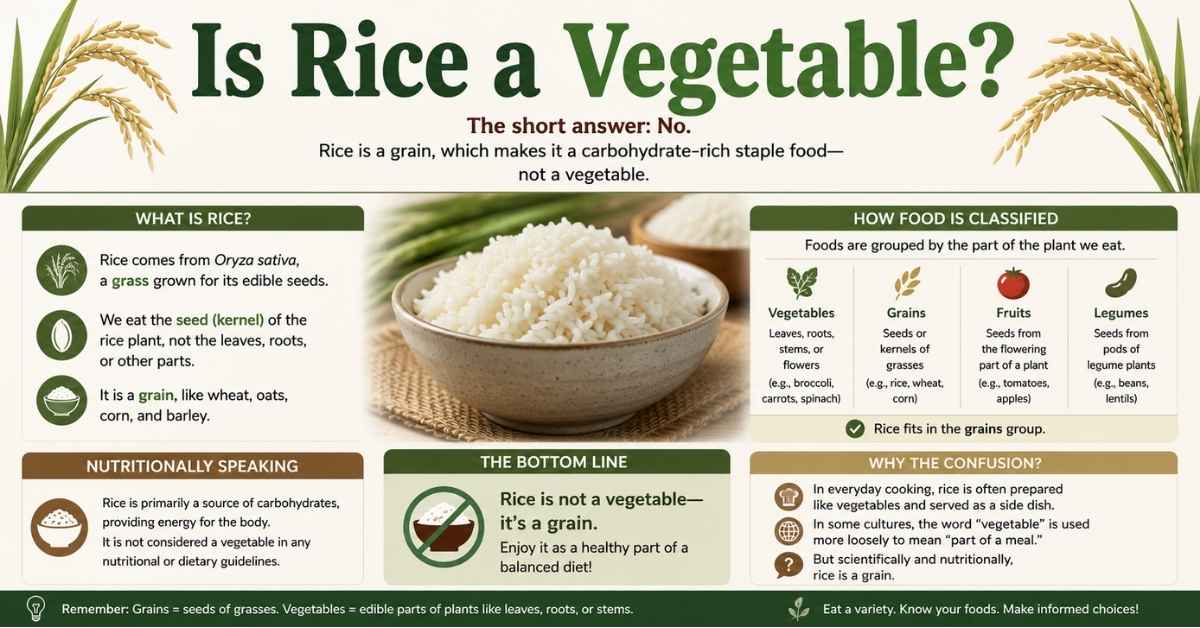
Is rice a vegetable? No, rice is not a vegetable. Rice is a cereal grain harvested from the seeds of the rice plant. Although rice comes from a plant, it belongs to the grain food group rather than the vegetable group in nutritional, agricultural, and scientific classifications.
This question confuses many people because rice is commonly served alongside vegetables, appears in healthy meals, and grows from a plant. It’s easy to assume that anything plant-based might be a vegetable. However, food classification is more complex than that.
Understanding whether rice is a grain, vegetable, carbohydrate, or seed can help you make better nutrition decisions, understand food labels, build balanced meals, and answer common food group questions correctly.
In this guide, you’ll learn exactly what rice is, why it is classified as a grain, how it differs from vegetables, whether rice counts as a vegetable serving, and where various types of rice fit into a healthy diet.
Quick Answer: Is Rice a Vegetable?
The simple answer is no.
The Rice is a grain, specifically a cereal grain, not a vegetable.
Rice Classification at a Glance
| Food | Vegetable | Grain | Fruit | Legume |
|---|---|---|---|---|
| Rice | No | Yes | No | No |
| Wheat | No | Yes | No | No |
| Corn | Sometimes | Yes | No | No |
| Beans | No | No | No | Yes |
| Potatoes | Yes | No | No | No |
Rice belongs to the same broad category as:
- Wheat
- Oats
- Barley
- Rye
- Corn
All of these foods are classified as grains because they are harvested for their edible seeds.
Why So Many People Think Rice Is a Vegetable
The confusion is understandable.
Rice Comes From a Plant
Many people associate vegetables with plants.
Since rice grows in fields and is harvested from a plant, it seems logical to think it might be a vegetable.
However, not every edible plant food is classified as a vegetable.
For example:
- Apples come from plants but are fruits.
- Beans come from plants but are legumes.
- Wheat comes from plants but is a grain.
The same principle applies to rice.
Rice Is Commonly Served With Vegetables
Rice frequently appears in dishes such as:
- Stir-fries
- Burrito bowls
- Curry dishes
- Fried rice
- Grain bowls
Because rice often shares a plate with vegetables, some people assume it belongs to the same food group.
Rice Is Popular in Vegetarian Diets
Another reason for confusion is that rice is commonly eaten by vegetarians and vegans.
Being plant-based does not automatically make a food a vegetable.
Rice is plant-based, but it remains a grain.
What Rice Actually Is
To understand why rice is not a vegetable, we need to understand what rice truly is.
Rice Is the Seed of a Grass Plant
Rice comes from plants in the grass family.
The edible portion we consume is the seed produced by the rice plant.
This is the same basic concept behind other cereal grains such as:
- Wheat
- Oats
- Barley
- Millet
Because the edible portion is the seed, rice falls into the grain category.
The Scientific Classification of Rice
- From a botanical perspective, rice is classified as a seed.
- From an agricultural perspective, rice is classified as a cereal crop.
- From a nutritional perspective, rice belongs to the grain food group.
All three systems reach essentially the same conclusion:
Rice is not a vegetable.
Why Rice Is Called a Cereal Grain
A cereal grain is the edible seed of a cultivated grass.
Common cereal grains include:
- Rice
- Wheat
- Oats
- Barley
- Sorghum
- Rye
Rice fits perfectly within this category because it is harvested for its seed rather than its roots, stems, leaves, or flowers.
The Three Ways Food Is Classified
One reason people become confused is that foods can be classified in different ways.
Botanical Classification
Botany focuses on plant structure.
Foods are classified based on which part of the plant is eaten.
Examples include:
- Roots: carrots, beets
- Leaves: lettuce, spinach
- Flowers: broccoli, cauliflower
- Seeds: rice, wheat, sunflower seeds
Under botanical classification, rice is a seed.
Culinary Classification
Chefs and cooks often classify foods differently.
Foods are grouped based on how they are used in recipes.
For example:
- Tomatoes are botanically fruits but often treated as vegetables in cooking.
- Rice is treated as a grain or starch in culinary settings.
Nutritional Classification
Nutrition professionals classify foods according to nutrient content and dietary guidelines.
Food groups typically include:
- Vegetables
- Fruits
- Grains
- Protein foods
- Dairy
Under nutritional classification, rice belongs firmly in the grain group.
Why These Systems Create Confusion
A food can have different classifications depending on context.
This explains why some foods appear confusing.
Rice, however, remains remarkably consistent across all major classification systems.
Whether you look at science, agriculture, or nutrition, rice is classified as a grain rather than a vegetable.
What Makes a Vegetable a Vegetable?
Understanding vegetables makes it easier to understand why rice is not one.
Characteristics of Vegetables
Vegetables are generally edible parts of plants such as:
- Leaves
- Stems
- Roots
- Flowers
- Bulbs
Examples include:
| Vegetable Type | Examples |
|---|---|
| Leafy Vegetables | Spinach, lettuce, kale |
| Root Vegetables | Carrots, radishes, beets |
| Stem Vegetables | Celery, asparagus |
| Flower Vegetables | Broccoli, cauliflower |
| Bulb Vegetables | Onions, garlic |
Why Rice Does Not Fit This Definition
Rice is not harvested for:
- Leaves
- Roots
- Flowers
- Stems
Instead, it is harvested for its seed.
This single fact is the primary reason rice is classified as a grain rather than a vegetable.
Rice vs Vegetables: What’s the Difference?
Although both come from plants, rice and vegetables play different nutritional roles.
Nutritional Comparison
| Nutrient | Rice | Vegetables |
|---|---|---|
| Carbohydrates | High | Generally lower |
| Fiber | Moderate | Often higher |
| Water Content | Lower | Higher |
| Calories | Higher | Usually lower |
| Vitamins | Moderate | Often higher |
| Minerals | Moderate | Often higher |
Calories and Energy
Rice is primarily an energy food.
Its carbohydrate content provides fuel for the body.
Vegetables generally contain fewer calories and lower carbohydrate levels.
Fiber Content
Whole grain rice, especially brown rice, contains fiber.
However, many vegetables provide significantly more fiber per serving.
Vitamins and Minerals
Vegetables tend to offer a wider range of vitamins, antioxidants, and phytonutrients.
Rice provides some nutrients but does not replace the nutritional benefits of vegetables.
Their Roles in a Healthy Diet
Rice and vegetables complement one another.
A balanced meal often contains both rather than choosing one over the other.
LEARN MORE: Can Chickens Eat French Fries?
Does Rice Count as a Vegetable Serving?
This is one of the most important hidden questions behind the keyword.
The answer is no.
Rice does not count as a vegetable serving.
Why Rice Belongs to the Grain Group
Nutrition guidelines place rice within the grain category because of its composition and agricultural origin.
When dietary recommendations suggest eating more vegetables, rice is not included in that target.
What Counts as a Vegetable Serving?
Examples include:
- Broccoli
- Spinach
- Carrots
- Green beans
- Bell peppers
- Cabbage
These foods contribute toward daily vegetable intake goals.
Rice does not.
Common Meal Planning Mistake
Many people create meals consisting of:
- Rice
- Protein
and assume the meal is complete.
In reality, vegetables still need to be added for better nutritional balance.
Is Rice a Grain, a Carbohydrate, or Both?
Many people ask whether rice is a grain or a carbohydrate.
The truth is that it is both.
Understanding Food Categories
Foods can belong to more than one category at the same time.
For example:
- Chicken is a protein food.
- Milk is a dairy product and a source of protein.
- Beans are legumes and also contain protein.
Rice follows the same principle.
Rice Is a Grain
The Rice belongs to the grain food group because it is the edible seed of a cereal grass.
Other foods in the grain category include:
- Wheat
- Oats
- Barley
- Rye
- Millet
Rice Is Also a Carbohydrate
Carbohydrates are nutrients rather than food groups.
Rice contains a significant amount of carbohydrates, making it an important source of energy.
This means rice can accurately be described as:
- A grain
- A carbohydrate-rich food
Both descriptions are correct.
Why This Distinction Matters
Many people mistakenly compare carbohydrates and grains as though they are competing categories.
In reality:
- Grain = food classification
- Carbohydrate = nutrient classification
Rice fits both categories simultaneously.
Are All Types of Rice Classified the Same Way?
Yes.
Whether you’re eating white rice, brown rice, wild rice, jasmine rice, or basmati rice, the classification remains essentially the same.
White Rice
White rice is processed to remove the bran and germ.
Although less nutrient-dense than whole grain varieties, it remains a grain.
Brown Rice
Brown rice retains its bran and germ layers.
It contains more:
- Fiber
- Minerals
- Antioxidants
However, it is still classified as a grain rather than a vegetable.
Wild Rice
Wild rice creates confusion because it differs botanically from traditional rice.
Despite these differences, wild rice is generally grouped with grains for nutritional and culinary purposes.
Black Rice
Often called forbidden rice, black rice remains a grain.
Its dark color comes from naturally occurring antioxidants called anthocyanins.
Jasmine Rice
Popular in Southeast Asian cuisine, jasmine rice belongs to the grain group.
Basmati Rice
Basmati rice, known for its distinctive aroma and long grains, is also classified as a grain.
Do Any Rice Varieties Count as Vegetables?
No.
Regardless of color, variety, processing method, or growing region, rice does not become a vegetable.
All common rice varieties remain part of the grain category.
Rice Compared With Other Commonly Confused Foods
Rice isn’t the only food that causes classification confusion.
Several other foods frequently raise similar questions.
Is Corn a Vegetable or a Grain?
Corn is one of the most misunderstood foods.
Depending on maturity and use, corn can sometimes be classified as:
- A vegetable
- A grain
This flexibility is one reason people become confused about rice.
Unlike corn, rice is consistently classified as a grain.
Are Potatoes Vegetables?
Yes.
Potatoes are vegetables because they are underground tubers.
Even though they are rich in carbohydrates, their classification remains vegetable.
Are Beans Vegetables or Legumes?
Beans belong to the legume family.
However, nutrition guidelines may count them as either a vegetable or protein source depending on dietary context.
Is Quinoa a Grain?
Technically, quinoa is a seed.
However, it is often grouped with grains because of its nutritional profile and culinary use.
Why Rice Is Different
Rice has one of the clearest classifications among common foods.
Across agriculture, nutrition, and culinary systems, rice consistently belongs to the grain category.
Why Food Classification Matters More Than Most People Realize
At first glance, the question may seem trivial.
However, understanding food groups has practical value.
Healthy Eating Decisions
Knowing whether a food is a grain or vegetable helps create balanced meals.
Many people unknowingly consume too many grains and too few vegetables.
Reading Nutrition Labels
Food labels and dietary recommendations often separate:
- Grains
- Vegetables
- Fruits
- Proteins
Understanding these categories improves nutrition awareness.
Teaching Children About Nutrition
Food classification is frequently taught in schools.
Parents often search questions like:
- Is rice a vegetable?
- What food group is rice in?
- Why isn’t rice a vegetable?
Clear explanations make nutrition education easier.
Building Better Meals
Once you understand where rice belongs, it becomes easier to create balanced plates that include:
- Whole grains
- Vegetables
- Protein sources
- Healthy fats
Can Rice Replace Vegetables in a Healthy Diet?
This is one of the most important practical questions.
The answer is no.
What Happens When Meals Include Rice but No Vegetables?
Rice provides:
- Energy
- Carbohydrates
- Some vitamins and minerals
However, it cannot provide the same nutritional diversity found in vegetables.
Missing vegetables may reduce intake of:
- Vitamin C
- Vitamin A
- Folate
- Potassium
- Antioxidants
- Phytonutrients
Nutrients Commonly Found in Vegetables
Vegetables contribute nutrients that grains generally lack in meaningful amounts.
This is why dietary guidelines encourage consuming a variety of vegetables daily.
Building a Better Plate
A balanced meal often includes:
- Rice or another grain
- Vegetables
- Protein
- Healthy fats
Meal Comparison Examples
| Meal | Balanced? | Reason |
|---|---|---|
| Rice only | No | Missing protein and vegetables |
| Rice and chicken | Better | Still needs vegetables |
| Rice, chicken, and broccoli | Yes | Includes all major food groups |
| Rice, vegetables, and beans | Yes | Balanced plant-based meal |
Where Rice Fits on a Healthy Plate
Rice can absolutely be part of a nutritious eating pattern.
The key is balance.
The Ideal Role of Rice
Rice works best as a supporting component rather than the entire meal.
It provides energy and complements other nutrient-dense foods.
Whole Grains vs Refined Grains
Whole grain options such as brown rice generally provide:
- More fiber
- More vitamins
- More minerals
Compared with refined grains, whole grains often offer greater nutritional value.
Choosing Better Rice Options
Health-conscious consumers often prefer:
- Brown rice
- Black rice
- Wild rice
These varieties typically provide more nutrients than highly refined white rice.
A Simple Plate Framework
Try dividing your plate into sections:
- Half vegetables
- One-quarter grains
- One-quarter protein
Rice fits into the grain section.
LEARN MORE: Can Chickens Eat Cheerios?
The Most Common Myths About Rice
Several myths continue to circulate online.
Myth #1: Rice Is a Vegetable
This is false.
Rice is a grain.
Myth #2: Rice Is Unhealthy
Rice itself is not inherently unhealthy.
Portion size, preparation method, and overall diet matter more.
Myth #3: Brown Rice Is a Vegetable
Brown rice is nutritionally different from white rice, but it remains a grain.
Myth #4: Rice Has No Nutritional Value
Rice provides:
- Energy
- Carbohydrates
- Minerals
- Some vitamins
Whole grain varieties provide even more nutrients.
Myth #5: Rice Can Replace Vegetables
Rice and vegetables serve different nutritional purposes.
One should not replace the other.
Real-World Situations People Ask About
School Homework Assignments
Many students search:
“Is rice a vegetable or grain?”
The correct answer is grain.
Weight Loss Meal Planning
People often wonder whether rice belongs in a healthy diet.
Rice can fit into weight management plans when portions are balanced appropriately.
Diabetes-Friendly Eating
People managing blood sugar often compare:
- White rice
- Brown rice
- Vegetables
Understanding food categories helps make informed choices.
Vegetarian and Plant-Based Diets
Rice is a staple food in many plant-based eating patterns but remains a grain rather than a vegetable.
Family Nutrition Questions
Parents frequently use food classification questions to teach healthy eating habits to children.
Expert Perspective: How Nutrition Professionals Classify Rice
How Dietitians View Rice
Registered dietitians generally place rice within the grain food group.
It is commonly counted toward daily grain recommendations.
How Agricultural Scientists Classify Rice
Agricultural experts classify rice as a cereal crop grown for its edible seeds.
Why Consistency Matters
Consistent food classification helps:
- Improve nutrition education
- Support dietary planning
- Simplify food labeling
- Reduce confusion
Across virtually every professional field, rice is recognized as a grain.
Frequently Asked Questions
Is rice a vegetable or grain?
Rice is a grain, specifically a cereal grain.
Does rice count as a vegetable serving?
No. Rice belongs to the grain group and does not count toward vegetable intake.
Why isn’t rice considered a vegetable?
Rice is harvested for its seeds rather than its roots, leaves, stems, or flowers.
Is brown rice a vegetable?
No. Brown rice remains a grain.
Is wild rice a vegetable?
No. Wild rice is generally categorized as a grain.
Is rice a carbohydrate?
Yes. Rice is rich in carbohydrates and is also classified as a grain.
Can rice replace vegetables?
No. Rice and vegetables provide different nutrients and should be consumed together as part of a balanced diet.
Is rice healthier than vegetables?
They serve different purposes. Vegetables generally provide more vitamins, minerals, and antioxidants, while rice primarily provides energy.
What food group does rice belong to?
Rice belongs to the grain food group.
Is rice considered a plant food?
Yes. Rice is a plant-based food, but it is classified as a grain rather than a vegetable.
Final Verdict: Is Rice a Vegetable?
No, rice is not a vegetable. Rice is a cereal grain harvested from the seeds of the rice plant. Whether you are talking about white rice, brown rice, jasmine rice, basmati rice, black rice, or wild rice, the classification remains the same.
While rice comes from a plant, it belongs to the grain food group, not the vegetable group. It provides carbohydrates and energy, but it does not count as a vegetable serving and should not replace vegetables in a healthy diet.
The easiest way to remember it is this:
Rice is a grain that complements vegetables, not a vegetable itself.