
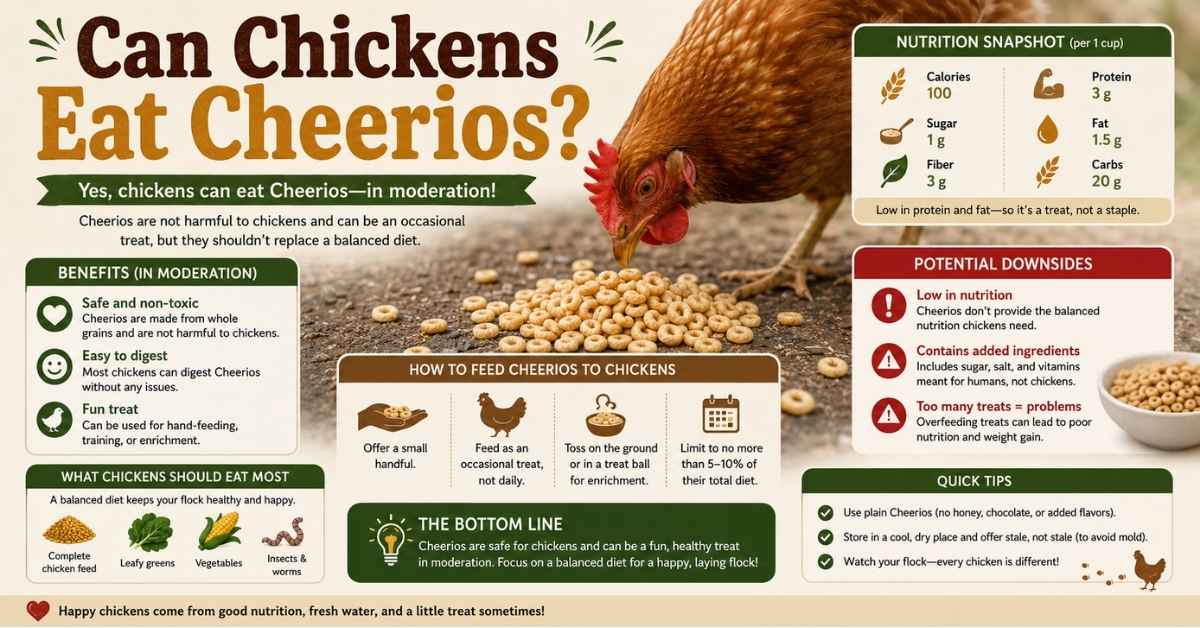
Can chickens eat Cheerios? Yes, chickens can eat plain Cheerios in moderation as an occasional treat. Since Cheerios are primarily made from whole grain oats, they are generally safe for adult chickens. However, they should never replace a balanced poultry feed because they lack the protein, amino acids, calcium, and other nutrients needed for proper growth, egg production, and overall flock health.
Many backyard chicken owners discover an old box of cereal in the pantry or find leftover breakfast cereal sitting on the table and wonder whether it can be shared with the flock. While chickens are known for eating a wide variety of foods, not everything humans eat is ideal for poultry nutrition.
The good news is that original Cheerios are usually safe for chickens, but there are important limits every flock owner should understand. Factors such as sugar content, feeding frequency, portion size, bird age, and overall diet all influence whether Cheerios are a harmless treat or a nutritional mistake.
In this guide, you’ll learn exactly how many Cheerios chickens can eat, whether Honey Nut Cheerios are safe, how Cheerios affect laying hens, and what happens if chickens eat too many.
Quick Answer: Can Chickens Eat Cheerios?
Yes, chickens can eat plain Cheerios as an occasional treat.
At-a-Glance Cheerios Safety Chart
| Cheerios Type | Safe for Chickens? | Frequency | Recommendation |
|---|---|---|---|
| Original Cheerios | Yes | Occasionally | Best choice |
| Multi-Grain Cheerios | Yes | Occasionally | Acceptable |
| Honey Nut Cheerios | Limited | Rarely | Use sparingly |
| Apple Cinnamon Cheerios | Limited | Rarely | Not ideal |
| Frosted Cheerios | No | Avoid | Too much sugar |
| Chocolate Cheerios | No | Avoid | Not recommended |
Key takeaway: Cheerios are considered a treat, not a replacement for complete chicken feed.
Why Chicken Owners Ask About Cheerios in the First Place
Most people searching “can chickens eat Cheerios” aren’t conducting nutritional research. They usually have a specific situation in mind.
Common Real-World Scenarios
Many flock owners find themselves with:
- Leftover Cheerios from breakfast
- Stale cereal nearing expiration
- Children sharing snacks with chickens
- An opened cereal box nobody wants to finish
- Temporary shortages of chicken feed
Rather than throwing food away, they want to know if their birds can benefit from it.
What Owners Are Really Worried About
Behind this simple question are deeper concerns:
- Will Cheerios make chickens sick?
- Can sugary cereals harm laying hens?
- Are processed foods dangerous for poultry?
- Could Cheerios reduce egg production?
- What happens if chickens already ate a large amount?
These concerns are reasonable because poultry nutrition directly affects flock health.
What Is Actually Inside Cheerios?
To understand whether Cheerios are safe, it helps to look at their ingredients.
Main Ingredients in Original Cheerios
Original Cheerios are primarily made from:
- Whole grain oats
- Corn starch
- Sugar
- Salt
- Vitamins and minerals
Compared to many breakfast cereals, original Cheerios contain relatively low sugar levels, which is one reason they are considered safer for chickens than heavily sweetened cereals.
Nutritional Breakdown for Chicken Owners
| Nutrient | Found in Cheerios | Importance for Chickens |
|---|---|---|
| Carbohydrates | High | Energy source |
| Fiber | Moderate | Supports digestion |
| Protein | Low | Insufficient alone |
| Sugar | Low to moderate | Should remain limited |
| Sodium | Present | Excess should be avoided |
| Vitamins | Fortified | Supplemental only |
Safe Does Not Mean Nutritious
One of the biggest mistakes flock owners make is confusing safe foods with nutritionally valuable foods.
A chicken can safely eat many things that contribute little to long-term health.
Cheerios fall into this category.
They are generally safe but do not provide the balanced nutrition found in:
- Layer feed
- Grower feed
- Starter feed
- Commercial poultry rations
A healthy flock requires proper levels of:
- Protein
- Amino acids
- Calcium
- Phosphorus
- Vitamins
- Minerals
Cheerios simply cannot provide these in sufficient amounts.
Can Chickens Digest Cheerios Properly?
The answer is usually yes.
Understanding the Chicken Digestive System
Chickens have a surprisingly efficient digestive system.
Food passes through:
- Crop
- Proventriculus
- Gizzard
- Small intestine
Because Cheerios are processed grain products made largely from oats, chickens can break them down relatively easily.
Why Whole Grain Oats Matter
The primary ingredient in Cheerios is whole grain oats.
Oats are commonly included in poultry diets and are generally well tolerated by chickens.
This is one reason plain Cheerios are considered safer than highly processed snack foods.
Do Chickens Need Grit When Eating Cheerios?
If chickens are free-ranging and already have access to grit, Cheerios typically pose no problem.
For confined flocks, access to grit helps the gizzard properly process grains and other foods.
Providing grit remains a best practice regardless of whether chickens occasionally eat Cheerios.
Are Cheerios Healthy for Chickens or Just an Occasional Treat?
This is where many articles fail to provide enough detail.
The Difference Between Chicken Feed and Chicken Treats
Complete chicken feed is formulated to meet nutritional requirements.
Treats are not.
Treats provide:
- Enrichment
- Variety
- Training opportunities
Feed provides:
- Protein
- Calcium
- Essential nutrients
- Balanced energy
Where Cheerios Fit in a Chicken Diet
Think of Cheerios the same way humans think about crackers.
They provide some energy but should not become a major dietary component.
Cheerios are best used:
- During training
- As occasional rewards
- For enrichment activities
- To encourage interaction with your flock
The 90/10 Treat Rule
Many poultry nutrition experts recommend that treats make up no more than 10% of a chicken’s overall diet.
That means:
- 90% complete feed
- 10% treats and supplemental foods
Following this guideline helps maintain healthy egg production and flock health.
How Many Cheerios Can Chickens Eat?
Portion control is more important than many owners realize.
Safe Portion Sizes
| Flock Size | Suggested Amount |
|---|---|
| 1–3 chickens | Small handful |
| 4–6 chickens | 1/4 cup |
| 7–12 chickens | 1/2 cup |
| Large flock | Scattered sparingly |
These amounts should be viewed as occasional treats, not daily feedings.
How Often Can Chickens Eat Cheerios?
A few times per week is generally acceptable.
Daily feeding is not recommended because repeated treats can reduce consumption of balanced poultry feed.
Signs You’re Feeding Too Many Treats
Watch for:
- Weight gain
- Reduced feed consumption
- Lower egg production
- Increased selective eating
- Nutritional imbalance
When these signs appear, treats should be reduced immediately.
Can Baby Chicks Eat Cheerios?
This question deserves special attention because chicks have very different nutritional needs than adult birds.
Why Chicks Need More Nutrition
Baby chicks require:
- High protein levels
- Balanced amino acids
- Proper growth nutrients
- Specialized starter feed
Their nutritional requirements are significantly higher than those of mature chickens.
Are Cheerios Safe for Chicks?
Crushed plain Cheerios are unlikely to be toxic to chicks.
However, they should not become a routine food source.
The priority for young birds should always be a high-quality chick starter feed.
Better Alternatives for Chicks
Healthier options include:
- Starter crumble
- Finely chopped boiled egg
- Appropriate chick treats
- Age-appropriate supplemental foods
These options support healthy development far better than cereal.
Can Laying Hens Eat Cheerios?
Yes, laying hens can eat Cheerios occasionally.
However, egg-laying birds require especially careful nutritional management.
Will Cheerios Affect Egg Production?
A few Cheerios are unlikely to cause problems.
The issue occurs when treats begin replacing nutritionally balanced feed.
Laying hens need:
- Calcium
- Protein
- Essential amino acids
- Vitamin D
When too many treats are fed, egg production can suffer.
Understanding Protein Dilution
Every handful of Cheerios replaces space that could be occupied by nutritionally complete feed.
This process is called nutrient dilution.
Over time, excessive treats may contribute to:
- Fewer eggs
- Smaller eggs
- Reduced shell quality
- Poor feather condition
For productive laying hens, moderation matters.
LEARN MORE: Can Chickens Eat Green Tomatoes?
Can Chickens Eat Honey Nut Cheerios?
Many flock owners specifically ask, “Can chickens eat Honey Nut Cheerios?” The answer is slightly different from plain Cheerios.
Why Honey Nut Cheerios Are Less Ideal
Honey Nut Cheerios contain:
- Added sugar
- Flavorings
- Additional sweeteners
- Processed ingredients
While a small amount is unlikely to harm healthy adult chickens, these cereals offer even less nutritional value than original Cheerios.
Are Honey Nut Cheerios Safe?
Yes, Honey Nut Cheerios are generally safe in small amounts, but they should be treated as a rare snack rather than a regular treat.
A few pieces scattered among a flock occasionally are usually fine.
An entire bowl should not become a routine feeding practice.
Why Sugar Matters
Chickens naturally consume:
- Seeds
- Grains
- Insects
- Vegetation
They do not require added sugars in their diet.
Excess sugar may contribute to:
- Weight gain
- Nutritional imbalance
- Reduced feed consumption
For this reason, original Cheerios remain the better choice.
Can Chickens Eat Flavored Cheerios?
Not all Cheerios varieties are equal.
Some contain significantly more sugar and artificial ingredients than others.
Apple Cinnamon Cheerios
These contain additional sweeteners and flavorings.
While not toxic, they should only be offered occasionally.
Chocolate Cheerios
Chocolate-flavored cereals are not recommended.
Although the amount of cocoa may be relatively low, there is little nutritional benefit and significantly more sugar.
Frosted Cheerios
Frosted varieties are among the least suitable options because of their high sugar content.
Multi-Grain Cheerios
These are generally similar to original Cheerios and can be offered occasionally.
Best and Worst Cheerios Varieties
| Variety | Safe? | Recommendation |
|---|---|---|
| Original Cheerios | Yes | Best option |
| Multi-Grain Cheerios | Yes | Good choice |
| Honey Nut Cheerios | Limited | Occasional only |
| Apple Cinnamon Cheerios | Limited | Rare treat |
| Frosted Cheerios | No | Avoid if possible |
| Chocolate Cheerios | No | Not recommended |
Can Chickens Eat Stale or Expired Cheerios?
One of the most common hidden searches is:
“Can chickens eat stale Cheerios?”
Stale vs Spoiled
There is a major difference.
Stale Cheerios simply lose freshness and crunch.
Spoiled Cheerios may contain:
- Mold
- Moisture damage
- Contamination
- Insect infestation
Stale cereal is usually safe.
Spoiled cereal is not.
How to Check Old Cheerios
Before feeding stale cereal, inspect it carefully.
Avoid feeding cereal that has:
- Mold spots
- Strange odors
- Visible moisture
- Pest contamination
Expired Cheerios
Expiration dates often relate to quality rather than safety.
A recently expired box that remains dry and mold-free is generally safer than wet or contaminated cereal.
When in doubt, throw it out.
What Happens If Chickens Eat Too Many Cheerios?
This is where problems can develop.
A handful of Cheerios rarely causes issues.
Large amounts over time are different.
Weight Gain
Cheerios provide carbohydrates and calories.
Excess calories without adequate activity may contribute to:
- Overweight hens
- Reduced mobility
- Lower productivity
Nutritional Dilution
The biggest risk isn’t toxicity.
The biggest risk is replacing balanced feed with low-value calories.
Every extra handful of cereal means fewer nutrients from:
- Layer feed
- Grower feed
- Protein-rich foods
Potential Impact on Egg Production
Laying hens require substantial protein and calcium.
Excessive treats may contribute to:
- Reduced egg production
- Thin shells
- Lower egg quality
Behavioral Issues
Too many treats can create picky eaters.
Some chickens begin waiting for treats instead of consuming their complete feed.
This creates long-term nutritional challenges.
Warning Signs
Reduce treats if you notice:
- Reduced feed intake
- Weight gain
- Poor feather condition
- Fewer eggs
- Increased begging behavior
Cheerios vs Other Popular Chicken Treats
Many owners wonder whether Cheerios are actually a good choice compared with other treats.
Cheerios vs Bread
Cheerios are generally a better option.
Bread offers little nutritional value and can become sticky when wet.
Cheerios vs Oats
Plain oats usually win.
Since Cheerios are primarily processed oats, feeding plain oats eliminates unnecessary additives.
Cheerios vs Corn
Corn provides energy but lacks complete nutrition.
Both should be considered occasional treats.
Cheerios vs Scratch Grains
Scratch grains are specifically formulated for poultry and are usually a better choice.
Cheerios vs Mealworms
Mealworms are far superior nutritionally.
They provide:
- Protein
- Amino acids
- Natural foraging stimulation
Nutrition Comparison Table
| Treat | Nutrition Value | Best Use |
|---|---|---|
| Layer Feed | Excellent | Daily feeding |
| Mealworms | High | Protein treat |
| Oats | Good | Occasional treat |
| Scratch Grains | Good | Supplemental feeding |
| Cheerios | Moderate | Occasional treat |
| Bread | Low | Rarely |
Better Treats to Feed Chickens Than Cheerios
While Cheerios are safe, several treats provide greater nutritional benefits.
High-Protein Treats
Examples include:
- Mealworms
- Black soldier fly larvae
- Boiled eggs
These support:
- Feather growth
- Muscle development
- Egg production
Natural Foraging Foods
Chickens naturally enjoy:
- Grass
- Weeds
- Seeds
- Insects
These foods mimic natural feeding behaviors.
Fruits and Vegetables
Popular choices include:
- Watermelon
- Cucumbers
- Pumpkin
- Lettuce
- Berries
Treats That Support Egg Production
Calcium-rich foods help laying hens maintain strong eggshells.
Examples include:
- Oyster shell
- Crushed eggshells
- Appropriate poultry supplements
Foods That Look Safe but Can Cause Problems
Many flock owners assume all human foods are safe.
That is not always true.
Sugary Snacks
Highly processed sweets can create nutritional imbalance.
Salty Foods
Too much sodium may stress a chicken’s system.
Moldy Foods
Mold is one of the most dangerous risks associated with feeding leftovers.
Common Feeding Mistakes
Avoid:
- Feeding spoiled food
- Overfeeding treats
- Replacing feed with snacks
- Ignoring nutritional balance
LEARN MORE: Can Chickens Eat Chives?
The Smart Way to Feed Cheerios to Chickens
If you decide to share Cheerios, do it strategically.
Scatter Feeding
Instead of dumping cereal into a pile, scatter it throughout the run.
This encourages:
- Foraging
- Exercise
- Mental stimulation
Training Chickens
Cheerios can be useful as a training reward.
Many owners use treats to:
- Encourage handling
- Build trust
- Train chickens to return to the coop
Reducing Boredom
Treats can enrich the environment, especially for confined flocks.
Used correctly, Cheerios become an activity rather than a meal.
Real-World Feeding Scenarios
You Have Leftover Cheerios After Breakfast
A small amount can be shared safely with healthy adult chickens.
Your Child Fed the Chickens Cheerios
There is usually no need to panic.
A few pieces are unlikely to cause problems.
Your Chickens Ate an Entire Bowl
Monitor them and return immediately to normal feed.
Most healthy chickens recover without issues, but overfeeding should not become a habit.
You Temporarily Ran Out of Feed
Cheerios can help bridge a very short emergency period.
However, they are not a substitute for complete poultry feed.
Expert Feeding Guidelines for Responsible Chicken Owners
Successful flock management is based on balance.
How Poultry Nutritionists View Treats
Most poultry nutrition experts agree that treats should complement feed, not replace it.
The foundation of flock health remains:
- Balanced nutrition
- Consistent feeding
- Proper protein levels
- Adequate calcium intake
Creating a Sustainable Treat Routine
A simple strategy is:
- Complete feed every day
- Treats occasionally
- Fresh water always available
- Grit provided when needed
Following this approach supports long-term flock health and consistent egg production.
Frequently Asked Questions
Can chickens eat Cheerios every day?
They can, but it is not recommended. Cheerios should remain an occasional treat rather than a daily food source.
Can chickens eat Honey Nut Cheerios?
Yes, but only in small amounts because they contain more sugar than original Cheerios.
Are Cheerios healthier than bread for chickens?
Generally yes. Cheerios contain whole grain oats and are usually a better option than white bread.
Can chicks eat crushed Cheerios?
They can, but chick starter feed should remain their primary source of nutrition.
Can Cheerios replace chicken feed?
No. Cheerios lack the balanced protein, calcium, vitamins, and minerals found in complete poultry feed.
Can chickens eat cereal with milk?
It is best to avoid feeding cereal soaked in milk. Chickens do not need dairy products regularly.
Will Cheerios affect egg production?
Occasional feeding is unlikely to cause problems. Excessive feeding may reduce nutritional intake and affect laying performance.
Are stale Cheerios safe for chickens?
Yes, provided they are dry, mold-free, and uncontaminated.
What cereal is safest for chickens?
Plain, unsweetened cereals with minimal additives are generally the safest options.
What happens if chickens eat too many Cheerios?
Overfeeding may lead to weight gain, nutrient dilution, and reduced feed consumption.
Final Verdict: Should You Feed Cheerios to Chickens?
Can chickens eat Cheerios? Absolutely. Plain Cheerios made from whole grain oats are generally safe for chickens when offered in moderation. They can serve as a fun treat, training reward, or occasional way to reduce food waste.
However, Cheerios should never replace a complete poultry ration. Chickens depend on balanced nutrition for healthy feathers, strong immune systems, proper growth, and reliable egg production.
The simplest rule to remember is this:
Feed Cheerios as a treat, not as a meal.
If your flock receives high-quality feed first and Cheerios only occasionally, there is little reason to worry. In fact, a small handful of plain Cheerios can become an enjoyable enrichment activity that both you and your chickens appreciate.