
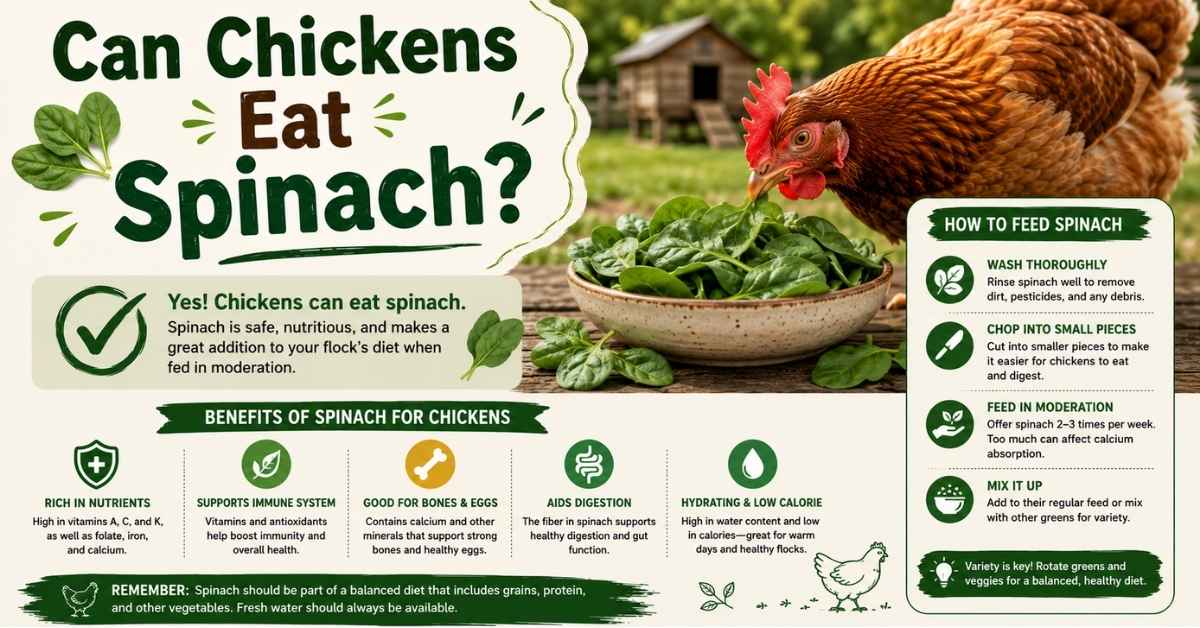
Can chickens eat spinach? Yes, chickens can eat spinach safely in moderation. This leafy green contains valuable nutrients such as vitamin A, vitamin K, iron, antioxidants, and fiber, making it a healthy occasional treat for backyard flocks. However, spinach also contains oxalates, natural compounds that can interfere with calcium absorption when fed excessively. For most chickens, spinach is best offered once or twice a week as part of a balanced diet rather than as a daily food.
If you’ve ever found leftover spinach in your refrigerator or harvested more spinach from your garden than your family can use, you may wonder whether your flock can enjoy it. The good news is that most chickens love pecking at fresh greens, and spinach can provide nutritional benefits when served properly. Understanding the benefits, risks, and feeding recommendations will help you make the best decision for your birds.
Quick Answer: Can Chickens Eat Spinach?
Yes, chickens can eat spinach, including raw spinach, baby spinach, and cooked spinach without harmful seasonings. Spinach is not toxic to chickens, but it should remain an occasional treat because its oxalate content may reduce calcium availability when fed in large quantities.
Quick Feeding Guidelines
| Question | Answer |
|---|---|
| Can chickens eat spinach? | Yes |
| Is spinach toxic? | No |
| Can laying hens eat spinach? | Yes, in moderation |
| Can chicks eat spinach? | Small amounts after introducing other foods |
| Can chickens eat spinach daily? | Not recommended |
| Best feeding frequency | 1–2 times weekly |
| Raw or cooked spinach? | Both are acceptable |
Spinach and Chickens: What Most Owners Get Wrong
Many chicken keepers encounter conflicting information online. One article claims spinach is a superfood, while another warns that it can damage eggshell quality. This contradiction often leaves owners confused.
Why Spinach Has a Confusing Reputation
The confusion comes from spinach’s high oxalate content. Oxalates are naturally occurring compounds found in many leafy greens, including spinach, Swiss chard, and beet greens.
Some poultry owners hear that oxalates bind to calcium and immediately assume spinach is dangerous. Others focus only on the vitamins and minerals and ignore the potential drawbacks.
The truth lies somewhere in the middle.
Is Spinach Actually Dangerous for Chickens?
For healthy chickens eating a balanced diet, spinach is generally safe. Problems usually occur only when spinach becomes a major part of the diet instead of an occasional treat.
A flock that receives quality layer feed, access to fresh water, and supplemental calcium sources is unlikely to experience problems from occasional spinach feeding.
Rather than viewing spinach as either completely good or completely bad, it is better to think of it as a nutritious treat that should be fed responsibly.
What Happens When Chickens Eat Spinach?
When chickens consume spinach, they receive a variety of nutrients that support overall health. Like other leafy greens, spinach can contribute to a more varied and enriching diet.
How Chickens Digest Leafy Greens
Chickens naturally forage for vegetation, insects, seeds, and plant matter. Their digestive systems are well-equipped to process greens.
After eating spinach, nutrients are broken down and absorbed through the digestive tract. The fiber content can also help support digestive health when offered in moderation.
Many backyard chicken owners notice their birds enthusiastically pecking at fresh spinach leaves because the texture and moisture content make them appealing.
Nutrients Chickens Can Get From Spinach
Spinach contains several nutrients that may benefit poultry health.
| Nutrient | Potential Benefit for Chickens |
|---|---|
| Vitamin A | Supports vision and immune function |
| Vitamin K | Supports bone health and blood clotting |
| Vitamin C | Provides antioxidant support |
| Iron | Helps oxygen transport |
| Magnesium | Supports muscle and nerve function |
| Fiber | Supports digestive health |
| Antioxidants | Help protect cells from oxidative stress |
Although spinach offers these nutrients, it should complement a complete poultry ration rather than replace it.
The Antioxidant Advantage
Spinach contains antioxidants that help combat oxidative stress within the body. While chickens primarily obtain nutrition from their formulated feed, antioxidant-rich treats may contribute to overall wellness and vitality.
For free-range flocks, spinach can also provide dietary variety and environmental enrichment, encouraging natural foraging behaviors.
The Real Concern: Oxalates and Calcium Absorption
Whenever people ask, “Is spinach bad for chickens?” they are usually referring to oxalates.
What Are Oxalates?
Oxalates are natural compounds found in spinach and several other leafy vegetables. These compounds can bind with calcium during digestion.
This does not mean spinach is poisonous. Instead, it means that excessive spinach consumption may reduce the amount of calcium available for absorption.
How Oxalates Interact With Calcium
Calcium plays a critical role in:
- Eggshell formation
- Bone strength
- Muscle function
- Overall health
When oxalates bind to calcium, some of that calcium becomes unavailable for use by the body.
For chickens consuming a balanced diet and receiving calcium from layer feed or oyster shell supplements, occasional spinach is rarely problematic.
Can Spinach Cause Thin or Soft Eggshells?
This is one of the most common concerns among poultry owners.
Theoretically, excessive spinach consumption could contribute to calcium deficiencies if spinach replaces more balanced food sources. However, occasional spinach treats are unlikely to cause eggshell problems in healthy laying hens.
Most soft-shell egg issues stem from:
- Poor nutrition
- Calcium deficiency
- Stress
- Age-related factors
- Illness
- Inadequate layer feed
Spinach alone is rarely the sole cause.
Should Backyard Chicken Owners Be Worried?
For most backyard flocks, the answer is no.
If spinach represents a small percentage of the diet and chickens have access to quality feed and calcium sources, the risk remains very low.
The key principle is moderation.
How Much Spinach Can Chickens Eat?
One of the biggest shortcomings in competing articles is the lack of practical feeding guidance.
Safe Portion Sizes by Flock Size
| Number of Chickens | Suggested Portion |
|---|---|
| 2–4 Chickens | Small handful |
| 5–8 Chickens | Medium handful |
| 9–15 Chickens | Large handful |
| 15+ Chickens | Several handfuls divided across feeding areas |
Treats should generally account for no more than 10% of a chicken’s overall diet.
How Often Should Chickens Eat Spinach?
A good rule of thumb is:
- 1–2 times per week for most adult chickens
- Rotate spinach with other greens
- Avoid feeding large quantities every day
Variety is beneficial because different vegetables provide different nutrient profiles.
Signs You’re Feeding Too Much Spinach
Watch for:
- Reduced consumption of balanced feed
- Increased dependence on treats
- Poor eggshell quality
- Nutritional imbalance
- Excessive selective eating behavior
These issues are usually associated with overfeeding treats in general rather than spinach specifically.
Can Chickens Eat Different Types of Spinach?
Not all spinach is served the same way.
Raw Spinach
Raw spinach is one of the easiest options to feed.
Benefits include:
- Retained nutrients
- Natural texture
- Easy preparation
Simply rinse thoroughly and offer fresh leaves.
Cooked Spinach
Cooked spinach is also safe for chickens.
Avoid:
- Butter
- Salt
- Garlic
- Onion
- Heavy seasonings
Plain cooked spinach is the safest choice.
Baby Spinach
Baby spinach is completely safe and often softer, making it easier for chickens to consume.
Nutritionally, it is very similar to mature spinach.
Frozen Spinach
Frozen spinach can be fed after thawing.
Avoid serving large frozen clumps, especially during colder weather.
Wilted Spinach
Slightly wilted spinach is usually acceptable if it remains fresh and free from spoilage.
Discard spinach that shows signs of:
- Mold
- Sliminess
- Unpleasant odors
Spinach Stems
Many chickens will peck at spinach stems without issues.
The stems are safe, although some birds prefer the leaves.
Spinach From Salad Mixes
Always inspect salad blends carefully.
Avoid mixes containing:
- Excess dressing
- High sodium ingredients
- Processed toppings
- Foods unsafe for poultry
Plain leafy greens are the best choice.
Can Baby Chicks Eat Spinach?
Baby chicks can eat spinach, but timing matters.
When Chicks Can Start Eating Greens
Most poultry keepers introduce greens after chicks are established on a quality starter feed.
Starter feed remains the nutritional priority during early development.
Risks of Introducing Greens Too Early
Overfeeding treats to young chicks can:
- Reduce starter feed intake
- Create nutritional imbalances
- Slow optimal growth
When introducing spinach, start with very small pieces and observe how chicks respond.
Can Laying Hens Eat Spinach?
Laying hens can safely eat spinach when it is offered as an occasional treat rather than a daily staple. Because egg production requires significant amounts of calcium, many chicken keepers worry that spinach could interfere with eggshell quality.
Spinach and Egg Production
There is no evidence that moderate spinach consumption directly reduces egg production in healthy hens. In fact, spinach provides several nutrients that can support overall health, including vitamin A, vitamin K, and various antioxidants.
A healthy laying hen requires:
- Quality layer feed
- Clean drinking water
- Adequate protein
- Consistent calcium intake
- Proper flock management
When these needs are met, spinach is unlikely to negatively affect laying performance.
Spinach and Eggshell Strength
Eggshell quality depends largely on calcium availability. Since spinach contains oxalates, excessive feeding could theoretically reduce calcium absorption.
However, occasional spinach treats are rarely responsible for thin-shelled eggs.
If eggshell problems occur, investigate:
- Calcium intake
- Feed quality
- Age of the hen
- Stress levels
- Parasites
- Underlying health issues
Balancing Calcium Needs in Layers
To support strong eggshell formation:
- Provide a high-quality layer feed.
- Offer free-choice oyster shell.
- Ensure access to clean water.
- Limit treats to about 10% of the overall diet.
This approach allows hens to enjoy spinach while maintaining optimal calcium levels.
Fresh Garden Spinach vs Store-Bought Spinach
Many backyard chicken owners grow spinach in their gardens. Others use leftover store-bought spinach.
Homegrown Spinach
Garden spinach offers several advantages:
- Freshness
- No unnecessary additives
- Reduced food waste
- Easy access during the growing season
Before feeding, inspect leaves for:
- Mold
- Rot
- Pest damage
- Chemical residues
Store-Bought Spinach
Store-bought spinach can also be fed safely.
Always:
- Wash thoroughly
- Remove spoiled leaves
- Check expiration dates
This helps reduce exposure to dirt and potential pesticide residues.
Organic vs Conventional Spinach
Both organic and conventional spinach can be fed to chickens.
The biggest factor is freshness rather than production method. Thorough washing is recommended regardless of whether spinach is organic or conventionally grown.
LEARN MORE: Is Rice a Vegetable?
Real-Life Feeding Scenarios Chicken Owners Face
Many articles discuss spinach in theory but fail to address real situations chicken owners encounter every day.
You Have Leftover Spinach in the Refrigerator
If the spinach is still fresh and free from spoilage, it can be a useful treat for your flock.
This is one of the easiest ways to reduce kitchen waste while providing enrichment.
Your Garden Produced More Spinach Than You Can Use
Extra garden spinach can be shared with chickens in moderation.
Consider rotating it with:
- Kale
- Lettuce
- Dandelion greens
- Cabbage
- Broccoli leaves
This promotes dietary variety.
The Spinach Is Slightly Wilted
Slight wilting is usually not a problem.
However, discard spinach if it becomes:
- Slimy
- Moldy
- Discolored
- Foul smelling
When in doubt, throw it out.
A Bag of Spinach Is Near Its Expiration Date
Fresh-looking spinach close to its expiration date is often still safe.
Inspect carefully before feeding.
Chickens Found Spinach on Their Own
Free-range chickens frequently sample various plants and greens.
If they discover spinach growing in the garden, occasional consumption is generally not a concern.
Best Leafy Greens for Chickens Compared
Spinach is not the only healthy green available to backyard flocks.
Spinach vs Kale
| Factor | Spinach | Kale |
|---|---|---|
| Oxalates | Higher | Lower |
| Calcium Availability | Moderate | Better |
| Vitamins | Excellent | Excellent |
| Feeding Frequency | Occasional | More Frequent |
Kale is often considered one of the best leafy greens for chickens because it provides nutrients without the same oxalate concerns.
Spinach vs Lettuce
| Factor | Spinach | Lettuce |
|---|---|---|
| Nutrient Density | High | Lower |
| Vitamins | High | Moderate |
| Fiber | Moderate | Moderate |
| Feeding Value | Higher | Lower |
Spinach vs Swiss Chard
| Factor | Spinach | Swiss Chard |
|---|---|---|
| Oxalates | High | Moderate to High |
| Nutrients | Excellent | Excellent |
| Feeding Frequency | Occasional | Occasional |
Both should be treated as supplemental greens.
Spinach vs Dandelion Greens
| Factor | Spinach | Dandelion Greens |
|---|---|---|
| Oxalates | Higher | Lower |
| Calcium Support | Moderate | Excellent |
| Feeding Frequency | Occasional | Frequent |
Many poultry keepers prefer dandelion greens because of their nutrient profile and lower oxalate content.
Ranking the Best Greens for Backyard Chickens
| Green | Nutrition Score | Calcium Support | Feeding Frequency |
|---|---|---|---|
| Kale | Excellent | Excellent | Frequent |
| Dandelion Greens | Excellent | Excellent | Frequent |
| Spinach | Excellent | Moderate | Occasional |
| Swiss Chard | Very Good | Moderate | Occasional |
| Lettuce | Good | Lower | Frequent |
Vegetables That Pair Well With Spinach
Providing a variety of vegetables can create a more balanced treat program.
Creating a Balanced Treat Mix
Consider combining spinach with:
- Cabbage
- Broccoli
- Cucumbers
- Peas
- Carrots
- Pumpkin
- Zucchini
These vegetables provide different nutrients and encourage natural foraging behavior.
Foods That Should Not Be Mixed Carelessly
Avoid overloading chickens with treats.
Too many vegetables can reduce consumption of nutritionally complete feed.
The goal is supplementation, not replacement.
Common Spinach Feeding Mistakes
Feeding Too Much at Once
Large quantities increase the likelihood of nutritional imbalance.
Small portions are more appropriate.
Replacing Balanced Feed With Greens
No vegetable should replace a formulated poultry ration.
Layer feed should remain the foundation of the diet.
Ignoring Calcium Requirements
This is especially important for laying hens.
Always provide adequate calcium sources.
Feeding Moldy Greens
Moldy vegetables can create serious health risks.
Never feed spoiled spinach.
Assuming All Leafy Greens Are Equal
Different greens contain different nutrient profiles.
Rotation is often better than relying on a single vegetable.
A Simple Spinach Feeding Framework for Backyard Flocks
Following a simple framework makes feeding decisions easier.
Step 1: Start Small
Offer a small handful and observe interest.
Step 2: Observe Flock Behavior
Watch how chickens consume the spinach and whether they continue eating their regular feed.
Step 3: Monitor Egg Quality
For laying hens, keep an eye on eggshell strength and consistency.
Step 4: Maintain Treat Balance
Keep treats under approximately 10% of the overall diet.
Step 5: Rotate Greens Regularly
Alternate spinach with other nutritious vegetables and leafy greens.
LEARN MORE: Can Chickens Eat Cheerios?
Signs Your Chickens Are Thriving on a Balanced Diet
Healthy Appearance Indicators
Look for:
- Bright eyes
- Clean nostrils
- Smooth feathers
- Good body condition
Egg Production Indicators
Healthy layers typically produce:
- Consistent eggs
- Strong shells
- Good yolk color
Behavioral Indicators
Thriving chickens are usually:
- Active
- Curious
- Alert
- Social
Feather Quality Indicators
Good nutrition often supports:
- Strong feather growth
- Healthy molting
- Better feather condition
What Poultry Experts Recommend About Spinach
General Consensus
Most poultry nutrition experts agree that spinach is safe when fed in moderation.
Areas of Agreement
Experts generally recommend:
- Balanced diets
- Diverse vegetables
- Quality layer feed
- Appropriate calcium supplementation
Areas Often Misunderstood
Many chicken keepers mistakenly believe spinach is either completely harmless or highly dangerous.
The reality is more balanced.
Evidence-Based Takeaways
- Spinach is not toxic to chickens.
- Oxalates are the primary concern.
- Moderate feeding poses little risk.
- Variety remains important.
Frequently Asked Questions
Can chickens eat spinach every day?
It is better to feed spinach occasionally rather than daily. Rotating greens helps maintain dietary balance.
Is spinach toxic to chickens?
No. Spinach is not toxic to chickens.
Can chickens eat cooked spinach?
Yes, plain cooked spinach is safe.
Can chickens eat frozen spinach?
Yes, after thawing and ensuring it remains fresh.
Can chickens eat spinach stems?
Yes, spinach stems are generally safe.
Can chickens eat spinach salad?
Only if the salad contains plain spinach. Avoid dressings, excessive salt, onions, and other unsafe ingredients.
Can baby chicks eat spinach?
Yes, in small amounts after they are established on starter feed.
Can roosters eat spinach?
Yes. Roosters can safely enjoy spinach in moderation.
Does spinach reduce calcium absorption?
Spinach contains oxalates that may bind to calcium, but moderate feeding is unlikely to create problems in healthy birds.
Is kale better than spinach for chickens?
Many poultry keepers prefer kale because it contains fewer oxalates while still providing excellent nutrition.
Can spinach affect eggshell quality?
Excessive spinach consumption could theoretically affect calcium availability, but occasional feeding is unlikely to cause issues.
What leafy greens are healthiest for chickens?
Kale, dandelion greens, spinach, cabbage leaves, and certain lettuce varieties are among the best options.
Final Verdict: Should You Feed Spinach to Chickens?
Can chickens eat spinach? Absolutely. Spinach can be a healthy addition to a backyard flock’s diet when served in moderation. It provides valuable vitamins, minerals, fiber, and antioxidants that support overall health and enrich a chicken’s feeding experience.
The key consideration is its oxalate content, which means spinach should not become a daily staple or replace a complete poultry ration. When offered once or twice per week alongside quality layer feed and adequate calcium sources, spinach is unlikely to cause problems for most chickens.
For the healthiest flock, think of spinach as one part of a varied menu that includes other nutritious greens such as kale, dandelion greens, cabbage, broccoli leaves, and lettuce. This balanced approach supports strong eggshells, healthy birds, and productive laying hens while allowing chickens to enjoy the benefits of fresh vegetables.