
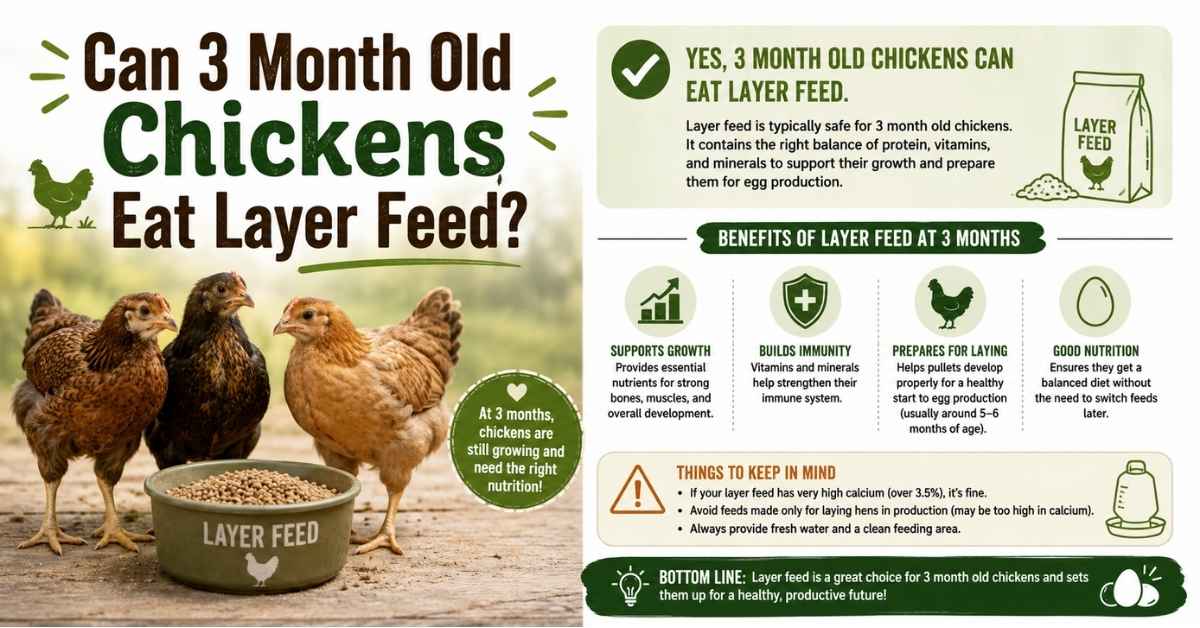
Can 3 month old chickens eat layer feed? In most cases, no, 3-month-old chickens should not be switched to layer feed yet. At around 12 weeks old, chickens are still considered growing pullets and typically benefit more from grower feed, grower developer feed, or all-flock feed rather than a layer ration designed for egg-laying hens. While a small amount of layer feed is unlikely to harm healthy birds, feeding it as their primary diet too early may provide more calcium than young chickens need before they begin laying eggs.
If you’re wondering whether your 12-week-old chickens can eat layer feed, when to switch feeds, or what happens if they accidentally consume layer pellets, this guide covers everything you need to know.
Quick Answer: Should a 12-Week-Old Chicken Be Eating Layer Feed?
Most poultry nutrition experts recommend keeping young chickens on grower feed until they approach laying age or lay their first egg.
Chicken Feed Transition Snapshot
| Chicken Age | Growth Stage | Recommended Feed |
|---|---|---|
| 0–8 Weeks | Chicks | Starter Feed |
| 8–16 Weeks | Growing Pullets | Grower Feed |
| 16–20 Weeks | Pre-Laying Pullets | Grower or Transition Feed |
| First Egg | Laying Hens | Layer Feed |
For the average backyard flock, grower feed vs layer feed is not a close contest at 12 weeks. Grower feed is usually the better choice because it supports continued development without unnecessary calcium supplementation.
Why This Question Causes So Much Confusion
Many chicken keepers receive conflicting advice.
One feed store employee may recommend switching to layer feed at 16 weeks. Another may suggest waiting until the first egg appears. Online forums often provide completely different recommendations.
What Chicken Owners Are Really Worried About
Most people searching this topic are asking:
- Will I hurt my chickens?
- Am I switching feed too early?
- Can excess calcium hurt pullets?
- What feed should 3-month-old chickens eat?
- Can young chickens and laying hens eat the same feed?
These concerns are valid because proper nutrition during development affects future health and egg production.
Understanding What Happens at 3 Months of Age
What a 12-Week-Old Chicken Is Still Developing
At approximately 12 weeks old, chickens are far from fully mature.
Their bodies are still developing:
- Skeletal structure
- Muscles
- Feather quality
- Reproductive systems
- Internal organs
Although many pullets begin looking like miniature hens, their nutritional needs remain focused on growth rather than egg production.
Why Pullets Are Not Yet Small Hens
A common mistake is assuming a larger pullet has the same dietary requirements as a laying hen.
In reality, pullets are still in an important growth stage where nutrients are directed toward development instead of eggshell production.
Growth Nutrition vs Egg Production Nutrition
This distinction is critical.
Grower feed supports:
- Growth
- Muscle development
- Skeletal strength
- Feather production
Layer feed supports:
- Egg production
- Eggshell quality
- Increased calcium demands
The nutritional goals are different.
What Layer Feed Is Designed to Do
Why Layer Feed Contains Extra Calcium
The defining feature of layer feed is its elevated calcium content.
Laying hens lose calcium every time they produce an egg. Without adequate calcium, eggshell quality suffers.
Layer feed helps prevent:
- Thin eggshells
- Soft-shelled eggs
- Calcium deficiencies
- Reduced laying performance
How Layer Feed Supports Egg Production
The feed is formulated specifically for birds whose reproductive systems are active.
Because most 3 month old chickens are not yet laying eggs, they often do not require these calcium levels.
Grower Feed vs Layer Feed
| Nutrient Focus | Grower Feed | Layer Feed |
|---|---|---|
| Growth | High Priority | Lower Priority |
| Egg Production | Minimal | High Priority |
| Calcium | Lower | Higher |
| Best For | Pullets | Laying Hens |
This is why grower feed remains the preferred option for most 12-week-old chickens.
The Calcium Question Most Articles Oversimplify
Many articles simply state:
“Layer feed contains too much calcium.”
The reality is more nuanced.
Why Young Chickens Need Different Calcium Levels
Growing birds require balanced mineral levels that support development.
Too much calcium during early growth may not provide any benefit and can interfere with ideal nutritional balance.
Is Layer Feed Dangerous or Just Poorly Timed?
For healthy pullets, eating some layer feed is rarely an emergency.
The issue is usually one of timing rather than toxicity.
A few bites or even a few days of layer feed are unlikely to cause significant problems.
The concern arises when layer feed becomes the long-term primary ration for immature birds.
Risk by Growth Stage
| Chicken Type | Layer Feed Suitability |
|---|---|
| Chicks | Poor |
| 12-Week Pullets | Not Ideal |
| 16-Week Pullets | Depends |
| Near-Laying Pullets | Often Acceptable |
| Laying Hens | Ideal |
Can 3 Month Old Chickens Eat Layer Feed in an Emergency?
If They Accidentally Ate Layer Feed
Don’t panic.
One of the most common searches is:
“What happens if pullets eat layer feed?”
In most cases, nothing serious happens if young chickens consume layer feed occasionally.
If Layer Feed Is All You Have
If you temporarily run out of grower feed, layer feed can serve as a short-term solution while you obtain the appropriate ration.
How Long Is Too Long?
There is no exact universal timeline.
However, feeding layer feed exclusively throughout the entire pullet stage is generally not recommended.
What To Do Next
Simply transition back to:
- Grower feed
- Grower developer feed
- Flock raiser feed
- All-flock feed
as soon as practical.
What Feed Should 3 Month Old Chickens Be Eating Instead?
Grower Feed
This is the standard recommendation for most 12-week-old chickens.
Benefits include:
- Balanced protein
- Controlled calcium
- Development support
Grower Developer Feed
Many feed manufacturers offer a grower-developer formula specifically designed for adolescent birds.
Flock Raiser Feed
Popular among backyard chicken keepers with mixed-age flocks.
All-Flock Feed
A flexible option that works well when multiple ages share the same coop.
For many homesteaders, all-flock feed with separate oyster shell becomes the easiest long-term feeding system.
The Hidden Problem: Mixed-Age Flocks
Why Feeding Gets Complicated
Many flock owners have:
- Pullets
- Laying hens
- Roosters
all living together.
This creates a feeding challenge because different birds require different nutrient levels.
Pullets and Hens Sharing a Coop
When young chickens share feeders with laying hens, owners often struggle to choose the right feed.
The Feeding Strategy Experienced Keepers Use
A common solution is:
All-flock feed + separate oyster shell
This allows:
- Pullets to avoid excess calcium
- Hens to access additional calcium
- Simpler feeding management
Why Separate Oyster Shell Works
The laying hens consume oyster shell as needed while younger birds typically ignore it.
This creates a more customized feeding system.
Exactly When Should Chickens Switch to Layer Feed?
Why First Egg Often Matters More Than Age
Many chicken keepers switch to layer feed too early because they focus only on age.
A better guideline is:
Transition when pullets begin laying eggs or show clear signs they are approaching lay.
Breed Differences Matter
Some breeds mature earlier than others.
Fast-maturing breeds may begin laying around 16–18 weeks.
Other breeds may not lay until 22–28 weeks.
Signs a Pullet Is Approaching Lay
Watch for:
- Enlarged combs
- Redder wattles
- Nesting behavior
- Increased interest in nest boxes
These signals often indicate a feed transition may soon be appropriate.
How to Read a Feed Bag Like an Experienced Poultry Keeper
Protein Percentage
Protein supports:
- Growth
- Feather quality
- Muscle development
Calcium Percentage
High calcium levels usually indicate layer feed.
Vitamins and Trace Minerals
Look for:
- Vitamin A
- Vitamin D
- Vitamin E
- Essential minerals
Red Flags Beginners Miss
Avoid selecting feed based solely on marketing claims.
Instead, compare:
- Feed purpose
- Protein levels
- Calcium content
- Age recommendations
Common Feeding Mistakes That Cause More Problems Than Layer Feed
Switching Too Early
One of the most common mistakes.
Feeding Excessive Treats
Treats should never replace balanced feed.
Ignoring Growth Stage Nutrition
Different stages require different nutrient profiles.
Assuming Every Bird Needs the Same Feed
Age and production status matter.
Real-Life Feeding Scenarios and Practical Solutions
You Accidentally Bought Layer Feed
Use it later when birds begin laying, or exchange it if possible.
Your Pullets Are Eating the Hens’ Feed
Short-term exposure is usually not a major concern.
You Have One Coop and One Feeder
Consider switching to all-flock feed and providing oyster shell separately.
Feed Prices Are Increasing
All-flock feed often provides flexibility for mixed-age flocks while reducing complexity.
Signs Your Pullets Are Developing Properly
Healthy pullets typically display:
Strong Growth
Steady weight gain and body development.
Good Feather Quality
Clean, smooth, well-developed feathers.
Strong Legs
Proper movement and activity.
Healthy Behavior
Alertness, curiosity, and normal social interactions.
Future Laying Readiness
Progressive comb and wattle development as maturity approaches.
When Feeding Practices May Need to Change
Consider adjusting feed if you notice:
- Poor growth
- Weight issues
- Delayed development
- Approaching laying age
- Seasonal changes
Regular observation often reveals when nutritional adjustments are needed.
LEARN MORE: Can Chickens Eat Capsicum?
Comparing Common Chicken Feeds
Starter Feed vs Grower Feed
Starter feed supports chicks during rapid early growth.
Grower Feed vs Layer Feed
Grower feed supports development.
Layer feed supports egg production.
Layer Feed vs All-Flock Feed
All-flock feed offers greater flexibility for mixed-age flocks.
Building a Feeding Plan From Hatch to First Egg
Weeks 0–8
Feed starter feed.
Weeks 8–16
Feed grower feed.
Weeks 16–20
Continue grower feed or transition feed depending on development.
First Egg and Beyond
Switch to layer feed.
This simple timeline works well for most backyard chicken flocks.
Frequently Asked Questions About Can 3 Month Old Chickens Eat Layer Feed
Can 12 week old chickens eat layer feed?
Yes, but it is generally not recommended as their primary feed.
What happens if young chickens eat layer feed?
Occasional consumption is usually not harmful.
Is layer feed bad for pullets?
It is generally less appropriate than grower feed because of its higher calcium content.
Can chickens switch to layer feed at 12 weeks?
Most poultry keepers wait until closer to laying age.
What feed is best for mixed-age flocks?
Many experienced keepers recommend all-flock feed with separate oyster shell.
Should pullets have access to oyster shell?
Typically no. Oyster shell is primarily intended for laying hens.
Is all-flock feed better than layer feed?
For mixed-age flocks, it often provides greater flexibility.
Final Verdict About Can 3 Month Old Chickens Eat Layer Feed
Can 3 month old chickens eat layer feed? Technically yes, but it is usually not the best choice. Most 12-week-old chickens, pullets, and young growing birds benefit more from grower feed, grower developer feed, or all-flock feed until they approach laying age. While occasional exposure to layer feed is unlikely to cause problems, long-term feeding is generally unnecessary before egg production begins.
For most backyard chicken keepers, the safest approach is simple: keep growing birds on grower feed and switch to layer feed when they begin laying eggs or show clear signs of reproductive maturity.